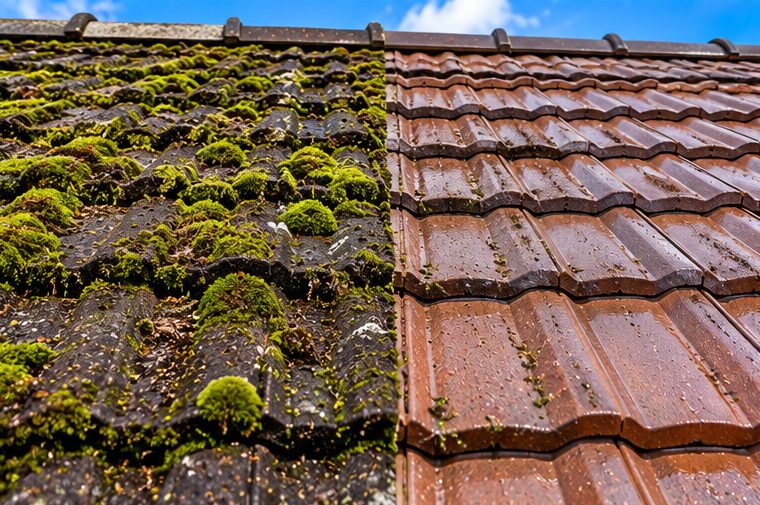
Moss gets most of the attention, but plenty of roofs suffer from two quieter growths. Algae shows up as dark, streaky staining that runs down the slope. Lichen forms flat, crusty patches in grey, green or orange that cling tightly to the surface. Neither looks good, and both can hold moisture against the roof covering over the years.
This guide explains how they differ, whether they are a real problem or mainly cosmetic, how roof algae removal and roof lichen removal are carried out gently, and what to expect from a quote. It is general advice for Lincolnshire homes, and the right approach always depends on the material and condition of your roof.
Getting the diagnosis right helps you choose the right treatment. Algae appears as black or dark grey streaks, usually starting on shaded or north-facing slopes and spreading downwards where water runs. Lichen is a combined organism that grows as raised or flat rosettes, tightly bonded to tiles and slates, sometimes in bright patches. Moss is thicker and cushion-like, with a visible green or brown growth. They often appear together, and damp, shaded roofs under trees tend to collect all three. Flat open country does not prevent them, since moisture in the air is enough for growth to take hold on a sheltered slope.
Algae on its own is mostly an appearance issue, although the stained surface can hold a little more moisture than a clean one. Lichen is more stubborn. Its roots grip into the surface, and over long periods it can contribute to wear on softer materials. It also tends to signal damp conditions that favour moss as well. A heavily coated roof can hold water, which is bad news in freezing weather. The honest answer is that light staining may not need urgent action, while thick, spreading growth deserves attention. A roofer looking at the actual surface can tell you which situation you have.
Tiles and slates can be damaged by rough treatment, so the method matters more than speed. Our approach uses:
Treated algae and lichen do not vanish instantly. Staining often fades over following weeks as the growth dies and weathers off, and heavily rooted lichen can take longer. That is normal and not a sign that the job has failed. We cannot promise a roof stays clean for a set time, because regrowth depends on shade, nearby trees, moisture and the roof material. A sensible plan is to keep gutters clear, trim back overhanging branches where you can and have the roof looked at periodically. Treating early, before growth thickens, is generally easier on both the roof and the budget.
A fair quote depends on the roof in front of us. The usual influences are:
F H Roofing is based in Beckingham near Lincoln and works across Lincolnshire, including around Lincoln, Louth, Boston and Spalding. Tell us what you see on the roof, which slopes are affected and whether the property is shaded by trees. We will look at the roof, suggest a gentle method that suits the material and provide a free quotation explaining what is included. If we notice repairs that are needed, we will say so plainly rather than bundling them into the job.
For roof algae and lichen removal anywhere in Lincolnshire, call or WhatsApp 07561 405402, or use the form below and tell us about the job.
Pictures are for illustration purposes only.
See all Roof Moss Removal services in Lincolnshire →
Algae is mostly cosmetic. Lichen grips more firmly and can contribute to surface wear over long periods, and both hold moisture. Light growth is rarely urgent, but heavy or spreading growth is worth treating before it takes a stronger hold.
It varies. After treatment, staining often fades gradually over the following weeks as the growth dies and weathers away. Lichen can be slower. We cannot promise a precise timescale because weather and the roof material both affect the result.
Not always. Low, easily reached roofs may be managed with suitable ladders and roof access equipment, while taller or steeper roofs often need scaffolding for safety. We will assess access when we visit and explain what is required.
Tell us about the job and we will be in touch.
Prefer to talk? Call 07561 405402 or WhatsApp us.