From a damp ceiling patch to a worn-out garage deck, we repair and renew flat roofs throughout Lincolnshire, and we explain what the roof actually needs before any work starts.
A flat roof is rarely completely flat. It is built with a slight fall so water drains off, and most trouble starts where that fall has been lost, where the covering has split, or where water has nowhere to go. Many leaks turn out to be small and local, which means a targeted repair can be perfectly sensible.
Other roofs are simply at the end of their life, and patching them is money thrown at a problem that will keep returning. We look at the whole roof, tell you which situation you are in, and quote for what is needed. Work is carried out for homes and small commercial buildings across Lincolnshire, and quotations are free.
Water inside the building is seldom directly below the hole in the roof. It runs along boards, insulation and joists before it shows itself, so a stain on a ceiling only tells you roughly where to start looking. Typical causes are splits and blisters in the covering, cracked or lifted edges, failed joints around rooflights and pipes, and ponding water that sits for days after rain. We check the surface, the upstands, the edge trims and the outlets, then work out whether the damage is isolated or spread across the roof. If the deck underneath is soft or the insulation is saturated, we say so, because covering over wet material only traps the problem.
Each flat roofing system has real strengths and real limits. Built-up felt is familiar and economical to lay but depends on good joints. Torch-on felt uses heat-bonded layers and suits many domestic roofs when fitted carefully. GRP fibreglass is laid wet and cures into a seamless, hard surface, which works well on small, neat roofs but needs a stable deck. EPDM is a flexible rubber sheet, popular for larger plain areas, and its performance relies on clean, well-sealed edges and details. The right choice depends on the shape of the roof, how often people walk on it, what the deck is made of and your budget. We will talk you through the trade-offs.
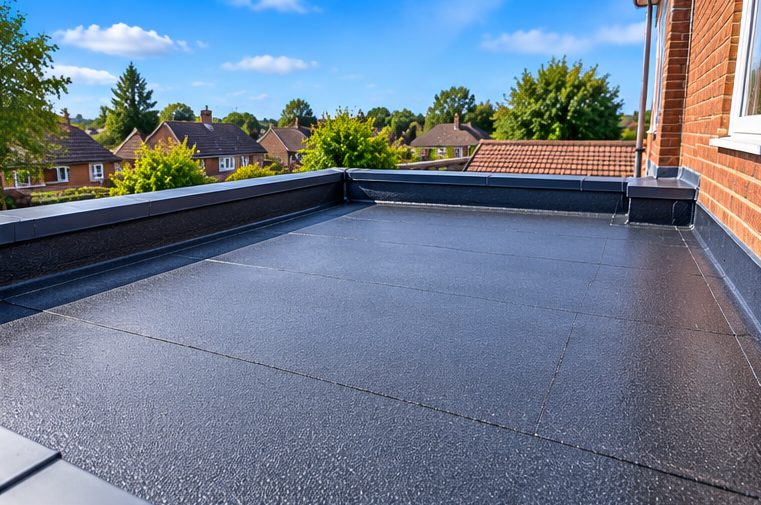
Garage and extension roofs take the most abuse, because they sit against walls, overhang gutters and often collect leaves and debris. The weak spots are almost always the junctions: the flashing where roof meets brickwork, the edge trims, and the outlets or gutters that carry water away. A perfectly good membrane can still leak if the flashing has lifted or the gutter is set so water backs up under the edge. When we repair or replace a flat roof, we look at these details as part of the job and fix the drainage so the new covering is not asked to deal with standing water.
If water is coming through, the first job is finding where it really enters. Our leaking flat roof repairs start with a careful look at splits, blisters, seams and penetrations, followed by flat roof leak detection that follows the damp back along the deck rather than guessing from the stain. Often the fix is local and modest. If the surrounding covering is tired, we will say so honestly.
Read the guide →When water is actively pouring in after a storm or a sudden failure, you need a response rather than a long quote cycle. We offer a 24-hour call-out for emergency flat roof repairs, aimed at stopping the ingress and protecting the building. A temporary seal is sometimes the sensible first step, with a proper repair or renewal planned once things are dry.
Read the guide →Some roofs are beyond saving. Repeated patching, soft boards, wet insulation and widespread cracking all point towards flat roof replacement. A new flat roof installation normally means stripping the old covering, checking the deck, laying insulation with a proper fall and fitting a fresh waterproof layer with sound edges and flashings. We will explain the options and what each involves.
Read the guide →Felt is still found on a great many sheds, porches, garages and older extensions. Felt roof repairs can work well for isolated splits, lifted laps or damaged edges. Where the felt is brittle, blistered or failing in several places, felt roof replacement is usually better value than chasing the next leak. We will show you what we find on your roof.
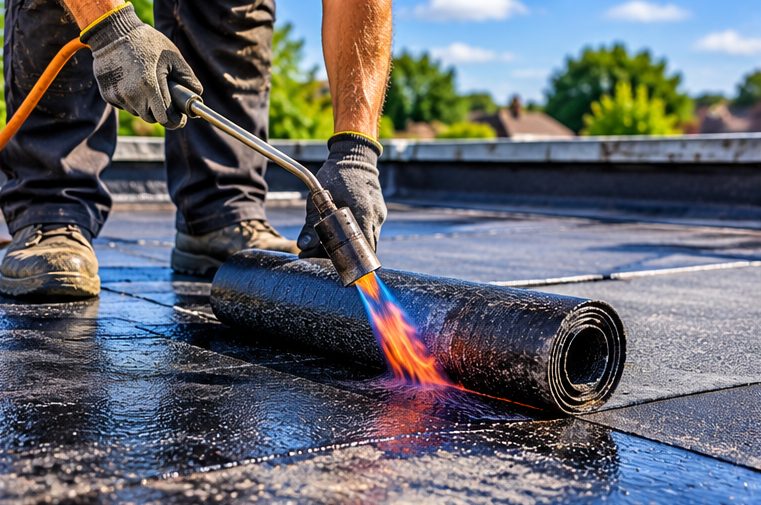
Read the guide →Torch-on felt roofing uses reinforced bitumen layers bonded to the roof with a gas torch, forming a joined, hard-wearing covering when properly laid. It suits many house extensions, porches and dormer-style flat areas. The quality depends heavily on the preparation, the lapping of the layers and the neatness of the details around walls and outlets, so those get proper attention.
Read the guide →GRP is built up on site from resin and glass matting, giving a seamless surface with no laps to open up. GRP fibreglass roof repairs can patch cracks and lifted edges, while GRP fibreglass roof installation suits smaller roofs on a solid, well-fixed deck. It is firm underfoot, but it can crack if the structure underneath moves, so the deck condition matters.
Read the guide →EPDM is a flexible synthetic rubber membrane supplied in large sheets, which means fewer joints across the main area. EPDM rubber roof repairs usually involve patching punctures or resealing edges and corners, while EPDM rubber roof installation is a popular choice for broad, plain roofs. Its success rests on clean surfaces, correct adhesives and carefully formed corners.
Read the guide →Many garage roofs have simply been left alone for decades. Garage flat roof repairs can deal with splits, lifted edges and leaking joints with the wall, and where the covering has reached the end of its life, garage roof replacement gives you a dry, sound building again. We check the boards, the fascia edge and the guttering while we are up there.
Read the guide →Extensions are often topped with a flat roof that meets the main house wall, a spot where leaks are common. Extension flat roof repairs focus on the abutment flashing, rooflight upstands, edge trims and outlets, as well as the membrane itself. Because the room below is usually lived in, we try to trace the cause properly rather than patching blindly.
Read the guide →Flat roof waterproofing is about the covering as a whole, not just a cosmetic coat on top. Depending on the age and condition of the roof, that could mean a repair that restores the existing surface, or a new waterproof layer over sound insulation and deck. We explain what suits your roof and, just as importantly, when a coating will not be enough.
Read the guide →Water that cannot escape will find another way in. Flat roof flashing repairs deal with lifted or cracked strips at walls, chimneys and rooflights, while flat roof drainage repairs cover clogged outlets, poorly set gutters and falls that leave puddles. Putting these right often stops leaks that the membrane itself was never causing.
Read the guide →Not every roof needs work, and it helps to know before it fails. Our flat roof inspections look at the surface, seams, edges, flashings, outlets and signs of ponding or movement, and we tell you plainly what we see. You may be told it needs nothing, a small repair, or planning for renewal. Inspections are useful before buying or after bad weather.
Read the guide →Select your town to see how we handle flat roof repairs locally.
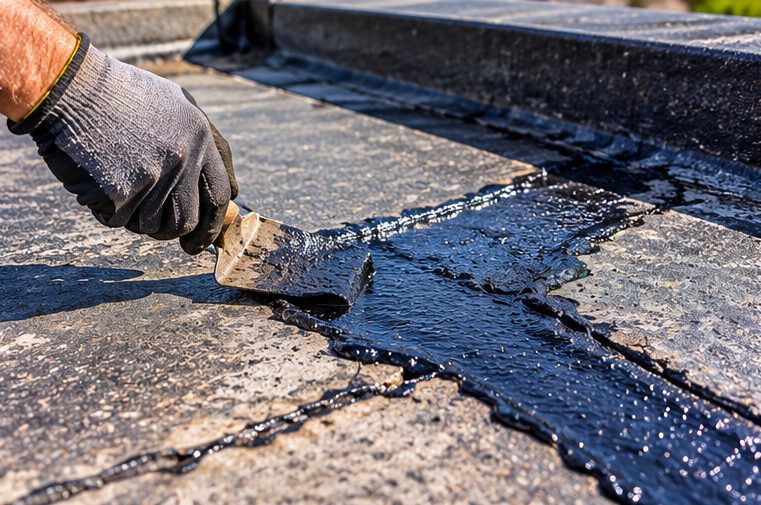
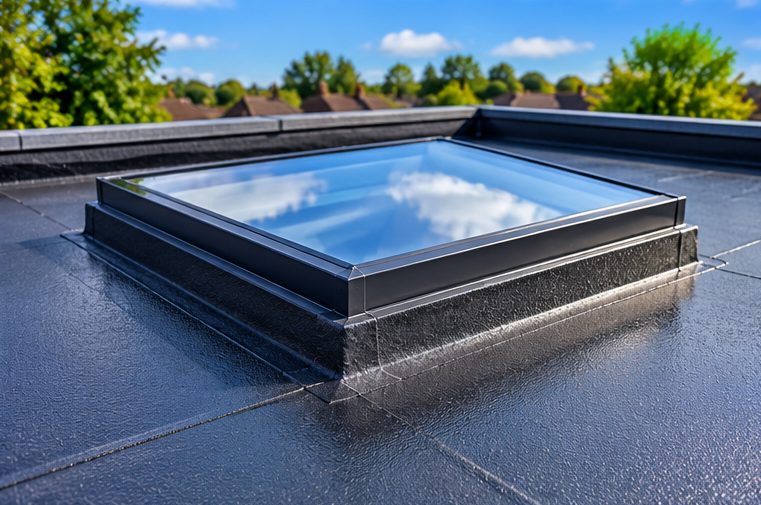
Pictures are for illustration purposes only.
“Brand new roof fitted and I couldn’t be happier. Excellent service, fast and efficient Very polite hard working men. Would highly recommend these”
“Excellent job fitting our new flat roof. The workmanship is top-notch and you can tell they take real pride in their work. Communication was great throughout, and they finished ahead of schedule. Would definitely use them again.”
“Very pleased with the guttering work done by F H Roofing. The team arrived on time, worked efficiently, and cleaned up afterwards. Everything works perfectly now — no more leaks or overflow!”
Many leaks come from a limited area, such as a split, a lifted edge or a failed joint at a wall, and these can often be repaired sensibly. If the covering is brittle, blistered in several places or the boards underneath are soft, replacement usually makes more sense than repeated patching.
It depends on the roof's size, shape, deck and how it is used. Felt and torch-on felt are familiar and practical, GRP gives a seamless hard surface on small roofs, and EPDM suits larger plain areas. We will go through the advantages and drawbacks of each for your particular roof.
Yes, we run a 24-hour emergency call-out service across Lincolnshire. We cannot promise an arrival time, since it depends on demand and conditions, but the aim is to stop water getting in and protect the property, then agree a lasting repair.
Yes, quotations are free. We look at the roof, explain what we find, and give you a written breakdown of the work. If it turns out nothing needs doing, or only a small repair is required, we will tell you that rather than suggest more work.
F H Roofing Lincolnshire, 3 Popular Meadows, Sleaford Road, Beckingham, Lincoln, LN5 0RB
Tell us what you need and we will be in touch.
Prefer to talk? Call 07561 405402 or WhatsApp us.