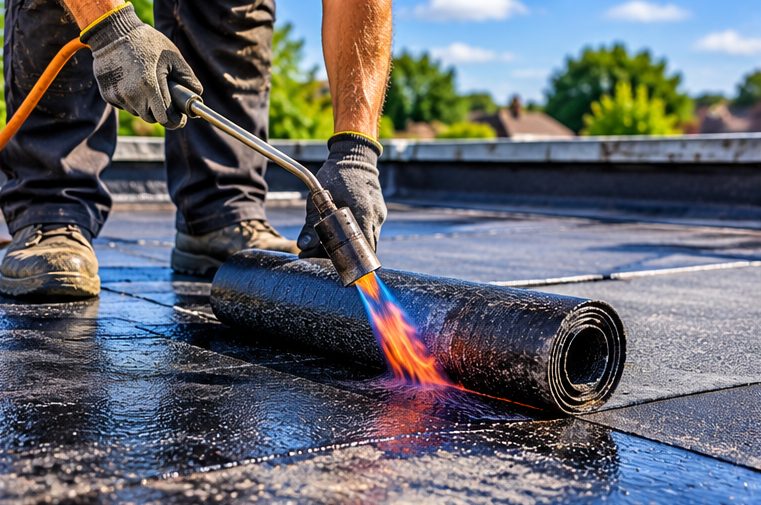
Torch-on felt roofing is one of the most familiar ways of covering a flat roof in the UK. Rolls of bitumen-based membrane are heated and bonded down in layers, giving a continuous waterproof skin over a garage, porch, shed, or house extension. Done carefully, it is a sensible and practical system that has been used on British homes for decades.
It is not magic, though, and it is not right for everything. The finished roof is only as good as the deck beneath it, the detailing at the edges and the care taken while it is laid. This guide explains in plain language how a torch-on felt roof is built, the honest strengths and weaknesses, and what to ask when a roofer in Lincolnshire quotes for one.
A typical torch-on system is built up in layers. First the deck is checked: boards must be dry, firm and flat, and any rotten timber is cut out and replaced. A vapour control layer or primer may go down first, then insulation if the roof is being upgraded, and then the felt layers themselves. The first layer, often called the underlayer, is fixed or bonded to the deck. The cap sheet goes on top, with a mineral finish that protects the bitumen from sunlight. Each roll is heated with a gas torch just enough to soften the underside so it melts into the layer below, and the joints are overlapped and sealed. Upstands at walls are formed carefully, and edges are finished with trims so water runs off cleanly into the gutter. The detailing at these edges is where most leaks begin, so it deserves as much attention as the main surface.
Torch-on felt is popular for good reasons. It is a proven, widely understood system that can be laid on awkward shapes, around upstands and past rooflights. Repairs tend to be straightforward, because a damaged patch can be cut out and a new piece bonded in. Multiple layers give some resilience to ordinary wear. It also tends to cost less than some alternatives, although we make no claims about that here. The drawbacks matter too. It relies on skilled hand-laying, so the quality of the workmanship varies from job to job. Seams can open if poorly bonded. Standing water and heavy foot traffic shorten its life. Because it uses a naked flame, it needs careful working near timber, soffits and anything that can burn, and that is a reason to be wary of anyone who treats it casually. Other systems such as rubber or fibreglass may suit some roofs better.
Torch-on felt works well on garage roofs, single-storey extensions, porches, outbuildings and the flat sections over bay windows. These roofs are usually modest in size, have simple shapes, and are only walked on for maintenance. It is less suitable where the roof is a regular terrace or balcony, or where the deck is badly distorted. Where a pitch is nearly flat, water can sit in dips and age the felt early, so the falls need checking before work starts. Houses near trees deserve a thought too, because leaves collect in gutters and on the surface, hold water and encourage moss. In the end the choice of system depends on the deck, the shape, access and how you use the roof. A short inspection usually shows quickly whether felt is the right option or whether another membrane is a better match.
Most failures trace back to what happens before the felt arrives. Laying new felt over a damp or sagging deck traps moisture and invites blistering. Skipping proper upstand height lets rain splash over the edge of the flashing. Weak laps, poor edge trims and blocked outlets all let water in later. The following points are worth checking when you compare quotations:
A fair quotation for torch-on felt reflects the size of the roof and how many layers are specified, but also the condition of what lies beneath. Stripping an old covering takes time and produces waste to be removed. Replacing rotten decking and adding insulation increase the scope. Roofs with many penetrations, such as pipes, vents and rooflights, take longer to detail than a plain rectangle. Access plays a part, because moving materials to a first-floor roof is slower than working on a single-storey garage. Weather affects scheduling, since felt should be laid on a dry deck. When quotes differ, look at what is included rather than the bottom line, and ask for the specification in writing so you can compare each one fairly.
If you have a flat roof in Lincoln, Boston, Skegness, Spalding or the surrounding area and are weighing up felt, get in touch for a free quotation. We will look at the deck, the edges and the drainage, explain whether torch-on felt suits the roof or another system makes more sense, and set out the work in plain terms. If water is already coming in, say so, as that changes the order in which things are done, and we offer a 24-hour emergency call-out for urgent situations. A few photographs of the roof from an upstairs window can help us understand it before we visit, but please stay off the roof yourself.
For torch-on felt roofing anywhere in Lincolnshire, call or WhatsApp 07561 405402, or use the form below and tell us about the job.
Pictures are for illustration purposes only.
See all Flat Roof Repairs services in Lincolnshire →
It depends on the build quality, the layers used, the condition of the deck and how well the roof drains. A neglected roof ages sooner. Regular checks, clearing leaves from the surface and keeping outlets open all help. We would not promise a set lifespan.
Sometimes, if the existing covering is dry, flat and well bonded. Often the old layers are better stripped so the deck can be inspected. An inspection shows which route is sensible, and a good quotation will explain the reasoning.
It can be, when the work is carefully planned, with attention to nearby timber and a sensible check at the end of the day. Ask how fire risks are managed, and be wary of any contractor who has no clear answer.
Tell us about the job and we will be in touch.
Prefer to talk? Call 07561 405402 or WhatsApp us.