Many homes have a kitchen or living room extension finished with a flat roof, and many of those roofs are quietly leaking at the edges long before a stain appears on the ceiling. The roof is small, so it gets ignored, yet it is attached to a much older wall and has to cope with movement between the two.
This guide covers extension flat roof repairs for Lincolnshire homeowners. It explains where problems usually start, how repair differs from replacement, what the main waterproofing systems offer, and what to prepare before you ask for a free quotation from F H Roofing.
On an extension, the trouble is rarely in the middle of the roof. It is more often at the junction with the main house wall, where the covering is turned up and sealed by flashing. If that joint opens, rain tracks behind it and appears inside as a damp patch near the wall. The next weak points are the edges, where the covering meets the trim and the gutter, and any penetrations such as rooflights, vents or pipes. Ponding water is another sign. If puddles stay on the surface a day or two after rain, the fall is poor or the deck has sagged, and standing water ages most coverings faster. A quick look from an upstairs window, or a ladder-free check with a camera on a pole, can tell you a lot.
A localised fault, such as a split seam, a lifted edge or a failed sealant line at a rooflight, can often be repaired neatly. The key is that the surrounding covering is still sound and the deck underneath is dry and firm. If the roof has blisters across large areas, repeated patches from earlier leaks, or soft boards you can feel when walking is judged safe, repeated repair stops being sensible. Water that has been getting in for a long time can soak the insulation and rot the timber, and covering over a wet deck simply traps the problem. A decent roofer will tell you plainly when a patch will hold and when it is only buying time. We would rather explain the choice than sell you a repair that fails again next winter.
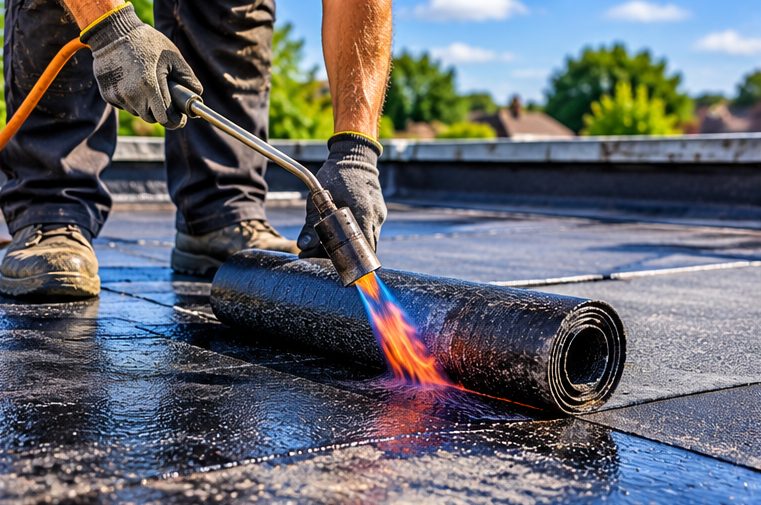
Extension roofs are commonly finished in one of three ways. Felt systems, including torch-on, are widely used, can be repaired in sections and suit most shapes, though they rely on good workmanship at the laps and details. Rubber membranes are supplied in large sheets, which means fewer joins on a simple roof, but awkward shapes need more careful detailing. Fibreglass is formed on site into a seamless surface that bonds to the deck and copes well with complex outlines, but it needs a dry, well-prepared deck and a stable structure, as it can crack with movement. None is perfect for every house. The deck condition, the roof shape, access and how the roof will be used, for example whether people will walk on it, should steer the choice.
Between visits from a roofer, a few habits make a difference. Keep gutters and outlets clear, because leaves blocking an outlet cause ponding and overflow at the edges. Remove debris gently by hand and avoid scraping the surface with metal tools. Watch trees that overhang the extension, as shade encourages moss and branches can scuff the covering. Look at the ceiling inside after heavy rain, and note the position of any mark, as that helps pinpoint the entry point. Do not leave heavy items stored on the roof, and avoid walking on it unless it is meant to take foot traffic. A short seasonal check, in autumn and again in spring, catches many problems when a repair is still small.
The quote for extension flat roof repairs depends on what is actually wrong. A single failed joint is a different job from a roof with wet insulation. Size and shape matter, as do the number of rooflights and upstands. Access is a factor because a ground-floor extension is easier to reach than one behind a two-storey house. The covering you choose, and whether the deck needs patching or replacing, changes the scope. If the work reveals hidden rot, we will tell you before carrying on, so there are no surprises. A site visit is the dependable way to get a fixed quotation, and we will explain what is included and what would count as extra.
We are based in Beckingham near Lincoln and cover Lincolnshire, including Gainsborough, Spalding and Skegness. To start, use the phone or WhatsApp buttons on this page. Tell us the approximate size of the extension, how old it is if you know, where any damp has appeared inside and whether the water seems to come in only in heavy rain or all the time. Photos of the roof edge and the wall junction help. We will then arrange a free quotation and talk you through whether repair or replacement makes sense, and why. If the leak is serious, mention it, as we offer a 24-hour emergency call-out.
For extension flat roof repairs anywhere in Lincolnshire, call or WhatsApp 07561 405402, or use the form below and tell us about the job.
Pictures are for illustration purposes only.
See all Flat Roof Repairs services in Lincolnshire →
That junction relies on flashing and sealing, and the two structures can move slightly against each other. Over time the seal splits or the flashing lifts, letting rain track behind it. A close inspection will show whether a repair is enough or the junction needs re-forming.
Sometimes. If the covering and deck are otherwise sound, a well-made repair can give useful extra life. If the roof has widespread blisters, soft areas or earlier patches failing, replacement is usually the more sensible route. We will give you an honest view after inspecting it.
It is better not to, unless the roof was designed for foot traffic. Walking can damage the covering and is unsafe if the surface is wet or mossy. Clear gutters and outlets from a ladder at the edge, or ask a roofer to do it during a visit.
Tell us about the job and we will be in touch.
Prefer to talk? Call 07561 405402 or WhatsApp us.