A flat roof tends to fail at the worst moment: a heavy overnight downpour, ceiling plaster sagging, water dripping onto a bed or a kitchen worktop. If that sounds familiar, this guide explains what Emergency Flat Roof Repairs actually involve, what you can safely do while you wait, and what a roofer looks for once they reach the roof. Most flat roof leaks have a simple cause, and many can be made watertight without replacing anything.
Not every leak is a true emergency, and not every emergency needs a whole new roof. The aim of a first visit is usually to stop water getting in, then work out calmly what the proper repair should be. F H Roofing is based in Beckingham near Lincoln, covers Lincolnshire, and offers a 24-hour emergency call-out service, though we never promise arrival times because they depend on conditions and demand on the day.
Water coming through a ceiling, a light fitting filling with moisture, or a ceiling bulging with trapped water all count as urgent. So does a roof covering that has torn open or lifted in strong wind. A stain that has appeared slowly over several weeks is different: it needs attention, but usually not in the middle of the night. Ponding is another clue. Standing water that stays on the surface for days suggests the roof is not draining properly, and that often ends in a leak sooner or later. Common causes of sudden failure include a split at a joint or upstand, a damaged edge trim, a blocked outlet that has let water back up, and storm debris puncturing the surface. Older roofs that were already tired are the most likely to give way during a spell of heavy rain.
You do not need to climb up, and you should not. Walking on a wet flat roof is risky, and a soaked deck can give way underfoot. These steps are safer and make the repair easier:
The first job is to find where the water is getting in, which is not always directly above the stain. Water can travel along the deck or insulation before it drops through the ceiling. A roofer will check seams, corners, upstands against walls, flashings, edge trims and outlets, and will look for blisters, cracks and punctures. Once the entry point is found, an emergency repair is usually a localised fix: a bonded patch over a split, resealing a joint or upstand, or clearing a blocked outlet. The purpose is to make the roof weathertight so the building stops taking in water. If the deck underneath is wet or soft, we will say so honestly, because covering a damaged area does not cure it. Sometimes a temporary covering is the sensible first step, with the full repair booked for drier weather.
Emergency work and permanent work are not always the same thing. A patch is often right when the rest of the roof is sound. Felt roofs can be patched with new layers bonded over the damaged section, which suits small areas but can leave a visible lump and may not hold if the surrounding felt is brittle. Fibreglass (GRP) roofs are rigid and can be repaired locally by laminating over a crack, though a flexing deck can cause the crack to return. Rubber (EPDM) sheets can be mended with specialist tape and adhesive, which is quick on a clean, dry surface but depends on good preparation. If the covering is worn out across its whole area, repeated patching becomes poor value and replacement is the more honest advice. We will tell you which category yours falls into.
Emergency work is priced on what is found, so we avoid quoting over the phone before anyone has seen the roof. The main factors are the size of the roof and how easy it is to reach, the type of covering, how many problem areas there are, and whether the deck or insulation has absorbed water and needs replacing. Access matters too: a single-storey garage roof reached from the ground is simpler than a roof over a first-floor extension that needs ladders or scaffolding. Weather affects what can be done on the day, and out-of-hours call-outs may be handled differently from planned work. Where a quick temporary repair is followed by a full repair later, we will explain both stages so you can see what each one is for.
If your roof is leaking now, use the phone or WhatsApp buttons on this page and tell us it is urgent. For work that can wait a little, the same buttons will get you a free quotation. It helps to describe the building, where the leak shows inside, roughly how old the roof is, and what the weather is doing. Photos taken from a safe spot are useful. We work across Lincolnshire, including Lincoln, Boston, Sleaford, Grantham, Louth, Skegness, Spalding and Gainsborough. We will not promise a time of arrival, but we will tell you plainly what we can do and what the repair is likely to involve.
For emergency flat roof repairs anywhere in Lincolnshire, call or WhatsApp 07561 405402, or use the form below and tell us about the job.
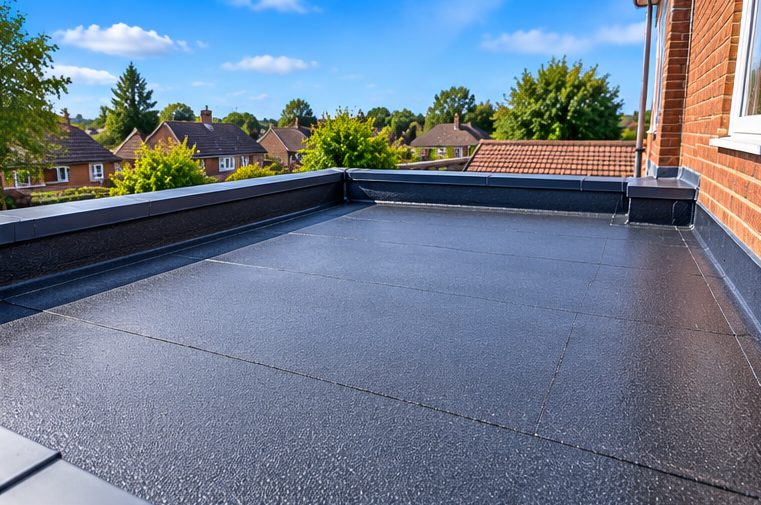
Pictures are for illustration purposes only.
See all Flat Roof Repairs services in Lincolnshire →
Temporary measures are sometimes possible in wet weather, such as sealing a split or covering a damaged area, but adhesives and bonded repairs work properly only on dry surfaces. A roofer will tell you what is sensible and safe on the day. If the proper repair has to wait for drier conditions, a temporary cover can limit further damage.
It is better not to. Wet flat roofs are slippery, and a deck that has been soaked may be weak. Look from a window or a safe spot on the ground, take photos, and leave the inspection to a roofer who has the right equipment and access to do it safely.
Sometimes, if the damage is small and the rest of the roof is healthy. More often it is a first step to stop water entering while the cause is investigated. We will explain whether the repair is likely to last or whether the roof needs further work, so there are no surprises later.
Tell us about the job and we will be in touch.
Prefer to talk? Call 07561 405402 or WhatsApp us.