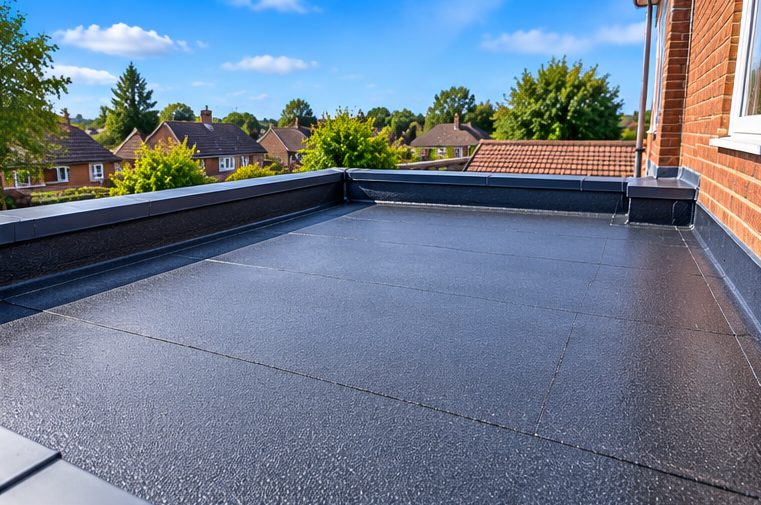
Fibreglass roofing, usually called GRP (glass reinforced plastic), has become a familiar choice for garage roofs, porch canopies, dormer tops and extensions. It is laid on site as a continuous surface, so there are no overlaps or seams across the main area in the way sheet coverings have. Done well, it is hard wearing and neat.
It is not magic, though. Like any flat roof covering, it depends on the deck beneath it, the way edges and upstands are formed and the weather on the day it is laid. This guide covers how the system goes down, when GRP Fibreglass Roof Repairs make sense, what GRP Fibreglass Roof Installation involves and where other materials may suit your property better.
A GRP roof is made on the spot. A sound, dry deck, typically boarded timber, is prepared first. Glass fibre matting is laid over it and saturated with liquid resin, which cures into a rigid, waterproof shell. A coloured top coat finishes the surface and gives it a smoother appearance. Trims and edge profiles are fitted at the perimeter so water runs off cleanly into the gutter. Because the surface is one continuous skin, there are fewer joints for water to find than with sheets that overlap. The cure is chemical, which is why temperature and dryness matter so much during the install.
Small, localised faults are often suitable for GRP Fibreglass Roof Repairs. A crack, a split at a corner, a damaged patch where something heavy landed, or a failed join around a rooflight can usually be cut back and rebuilt with new matting and resin. The important part is finding the actual cause. Hairline cracks can come from movement in the deck, so patching the surface without dealing with the movement means the crack returns. Standing water, softened decking or widespread surface crazing suggest the roof is nearing the end of its useful life, and then a full replacement may make more sense than repeated patching.
Whatever the covering, most flat roof failures begin with preparation. A proper GRP Fibreglass Roof Installation starts by checking the existing structure, then renewing any damaged boards and making sure falls direct water to the outlets. A flat roof that ponds is never ideal. Edge trims, upstands against walls, rooflight kerbs and the gutter line all need attention before the laminate goes on. Ask whether the old covering will be stripped or whether the new system will be built over it, and how the roof will be ventilated if insulation is being added. Laying should be done in dry conditions, with the resin properly mixed and cured before rain arrives.
No flat roof material suits every job, so weigh up both sides.
The size of the roof is only part of the story. The condition of the deck often decides the scale of the job, because rotten boards must be replaced before any covering goes on. Access, height, the number of edges and upstands, rooflights, how much old material has to be removed and taken away, and any added insulation all shape the quote. Choice of finish and colour can change things a little. Be wary of any quote that does not mention the deck, the edges or the drainage, as those are the places where flat roofs commonly fail. A written breakdown makes it easy to compare offers properly.
If your flat roof is leaking, cracked or simply worn out, we are happy to look at it and give a free quotation across Lincolnshire, including around Lincoln, Louth, Boston and Spalding. We will tell you honestly whether a repair is reasonable or whether the roof needs renewing, and whether GRP is the right covering for your property or another system would suit better. Tell us the roof size, what it covers and where you have seen water. Use the call or WhatsApp buttons on this page to arrange a visit.
For grp fibreglass roof repairs and installation anywhere in Lincolnshire, call or WhatsApp 07561 405402, or use the form below and tell us about the job.
Pictures are for illustration purposes only.
See all Flat Roof Repairs services in Lincolnshire →
Often, yes. A localised crack or damaged patch can usually be cut back and rebuilt with fresh matting and resin. The cause matters, though. If the deck is moving or soft, the crack may return, and a larger repair or renewal could be more sensible.
It suits many garages, extensions and dormers, but not every roof. The deck must be sound and the falls correct. Roofs with a lot of movement or very complex shapes may suit another covering. A site visit is the reliable way to decide.
It depends on the roof size, the state of the deck and the weather. Many smaller roofs are laid in a short period once preparation is done, but the resin must cure in dry conditions. We will explain the likely plan when we have seen the roof.
Tell us about the job and we will be in touch.
Prefer to talk? Call 07561 405402 or WhatsApp us.