Rubber roofing has become a familiar choice for garages, extensions, porches and summer houses. The material is a synthetic rubber membrane supplied in large sheets, so a small roof can often be covered with one piece and hardly any seams. That is its main attraction, because seams are where flat roofs tend to fail.
It is not a magic cure, though. A rubber membrane is only as good as the deck underneath and the detailing at the edges. This guide covers what EPDM rubber roof repairs and installation involve, the honest strengths and limits of the system, and what to ask before agreeing to work on your Lincolnshire property.
An EPDM roof is built in layers. At the bottom is the deck, usually timber boards or sheets, which must be dry, flat and firmly fixed. Many roofs have insulation laid over or under the deck, and a vapour control layer where the design calls for it. The rubber membrane goes on top, normally bonded down with adhesive, though ballasted and mechanically fixed methods exist for other situations. Edges are finished with trims, and upstands against walls are formed with the same rubber and sealed with purpose-made tapes and primers. Because the sheet is flexible, it copes well with the small movements that crack harder coverings, which is one reason it suits timber structures that expand and contract.
Every flat roofing system has trade-offs, and it is worth hearing both sides before choosing:
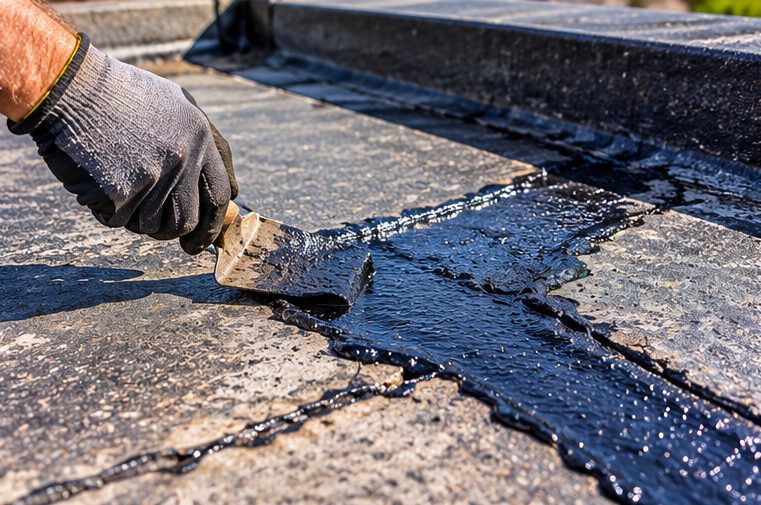
EPDM rubber roof repairs are often possible when the damage is local. A puncture, a lifted edge, a failed corner or a split near a pipe can usually be cleaned, primed and patched with a rubber repair piece and tape. The key is that the area must be dry and clean, because adhesive will not bond to damp or dusty rubber. Repairs become less sensible when the membrane has widespread blistering, lifted seams across large areas, or when the deck beneath is soft, wet or rotten. In those cases a patch only hides the problem. If water has been getting in for a while, it is worth checking the boards and insulation before anyone decides on a patch or a new sheet.
For EPDM rubber roof installation, the old covering is usually stripped back to the deck, unless the existing layers are sound and suitable to stay. The deck is inspected, damaged boards replaced, and falls checked, because water should drain rather than sit. Insulation and a suitable base layer follow where needed. The sheet is then unrolled, allowed to relax, and bonded in stages, folding back one half at a time. Corners are formed carefully, upstands are glued and sealed, and edge trims fixed. Drainage details, such as outlets or gutters, finish the job. A tidy installer will also protect the garden and surrounding surfaces and take away the waste. Allow for weather, since adhesives need suitable conditions, so timings often depend on the forecast.
The size and shape of the roof set the amount of material and labour, but they are not the only factors. Awkward access, tall walls that need long upstands, rooflights, vents, pipes and chimneys all add detail work. Whether the existing covering can come off easily, whether the deck needs repairs, and whether insulation is being added all change the scope. Drainage alterations and new trims or gutters are also part of it. A quote that simply states a size and a total, without mentioning deck condition or edge details, leaves room for surprises. Ask what happens if rotten boards are found, and how that would be agreed with you.
F H Roofing is based in Beckingham near Lincoln and covers Lincolnshire, and quotations are free. Contact us with the roof type, roughly how large it is, what is leaking or failing, and any photos you can take safely. We will look at the deck, the edges and the drainage, tell you whether repair or renewal looks right, and explain the reasoning. If rubber is not the most suitable covering for your roof, we will say so and talk through the alternatives rather than push one system. You can then compare our quote against others on the same basis.
For epdm rubber roof repairs and installation anywhere in Lincolnshire, call or WhatsApp 07561 405402, or use the form below and tell us about the job.
Pictures are for illustration purposes only.
See all Flat Roof Repairs services in Lincolnshire →
Sometimes, but only if the old covering is sound, dry and compatible, and the deck is in good order. In many cases it is better to strip back to the boards so any hidden damage can be seen and put right before the new sheet goes down.
It suits many small and medium roofs such as garages, porches and extensions. Roofs with heavy foot traffic, complicated shapes or poor drainage may need a different approach. An inspection is the only reliable way to decide.
Small roofs are often done in a day or two, while larger ones or those needing deck repairs take longer. It depends on size, access and weather, because adhesives need dry conditions. We would give you a realistic idea at the quotation stage.
Tell us about the job and we will be in touch.
Prefer to talk? Call 07561 405402 or WhatsApp us.