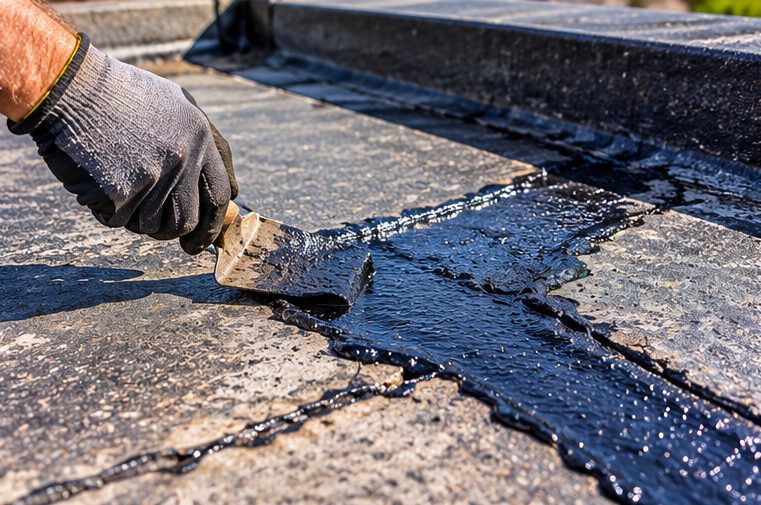
When a flat roof leaks, owners tend to blame the membrane in the middle. In practice a large share of problems start at the edges: where the roof meets a wall, where it finishes at a gutter, or where water sits because it has nowhere to go. Flat Roof Flashing Repairs and drainage work deal with exactly those weak points, and they are often more sensible than replacing the whole surface.
This guide explains how flashings and drainage fail, how repairs are normally carried out, and the honest advantages and drawbacks of the common waterproofing systems. It is aimed at Lincolnshire homeowners with garage, porch or extension roofs. Lincolnshire sees a lot of wind and rain across open country, so the details at the edges matter. We do not name product brands here, because the right choice depends on your roof.
Where a flat roof meets a wall, the waterproofing has to turn up the brickwork and be sealed at the top. That junction moves with temperature and settles over time, so sealant dries out, mortar behind it crumbles and the upstand lifts. Water then runs behind it into the building. The same applies around rooflights, pipes and abutments with a neighbouring property. A roof surface can be in decent shape while a failed junction drips into a bedroom, which is why a careful inspection of every edge and penetration comes before anything gets ripped up.
Flat Roof Flashing Repairs depend on what the junction is made from. Lead is long-lasting and workable but needs skilled fitting, and it needs the wall behind it to be sound. Membrane upstands can be cut back and re-bonded where the roof covering allows. Flexible strips and sealants can help as a stopgap, but a bead of sealant alone is rarely a lasting fix. A proper repair normally involves:
Standing water is the other big cause of failure. Flat Roof Drainage Repairs start with the simple things: blocked outlets, sagging gutters, joints that leak, and falls that have shifted so water pools. Persistent ponding adds weight and speeds up wear on the surface, and in winter it freezes. Sometimes clearing and re-fixing the outlet is enough. Where a roof was laid with poor falls, the honest answer may be adding tapered insulation or boards during a re-cover, because patching cannot change the shape of the roof. Overflow routes matter as well, so heavy rain has somewhere safe to go.
Felt, rubber sheet and fibreglass all have a place. Felt is familiar and repairable in sections, but seams and edges need good workmanship and it can age at the laps. Rubber sheet comes in large pieces with fewer joins, which suits simple shapes, though cutting in around awkward details demands care. Fibreglass forms a seamless surface that bonds well to boards, yet it needs a sound, dry deck and suitable weather to cure. For a repair, the question is also compatibility: a patch has to work with what is already there. We will explain what suits your roof, and we will say if repair is no longer sensible.
Edge and drainage repairs range from a small local fix to rebuilding a whole junction. What moves the quote most is the length of flashing involved, how hard it is to reach, and whether the wall or outlet behind it needs work first. Rotten boards or wet insulation found underneath will add to the job, and we would rather tell you before starting than after. Access, including whether scaffolding is needed for a roof above ground floor, makes a difference too. The roof material and its age also decide whether a repair can be bonded in properly. A written quote that spells out what is covered helps you compare.
We are based in Beckingham near Lincoln and cover Lincolnshire, including areas around Lincoln, Boston and Gainsborough. When you get in touch, tell us where you see the leak or staining, how old the roof is, and whether water tends to pool after rain. Photos of the junctions and outlets help a lot. We will usually want to look at the roof in person before agreeing a repair, and the quotation is free. If water is coming in now, mention it, since we offer a 24-hour emergency call-out.
For flat roof flashing and drainage repairs anywhere in Lincolnshire, call or WhatsApp 07561 405402, or use the form below and tell us about the job.
Pictures are for illustration purposes only.
See all Flat Roof Repairs services in Lincolnshire →
Yes. Water often enters at a failed wall junction, around a rooflight or at a poorly sealed outlet, then travels some distance inside before showing as a stain. That is why we look at every edge and detail before suggesting the surface needs replacing.
Sealant can slow a leak for a short time, but it dries, cracks and loses grip as the roof moves. It suits a temporary measure while a proper repair is planned. A lasting fix normally means reforming the junction itself.
Light debris at ground-accessible outlets is fine, but do not walk on a flat roof or use ladders on your own if you are unsure. Roofs can be slippery and fragile. If water keeps backing up after clearing, ask for a drainage check.
Tell us about the job and we will be in touch.
Prefer to talk? Call 07561 405402 or WhatsApp us.