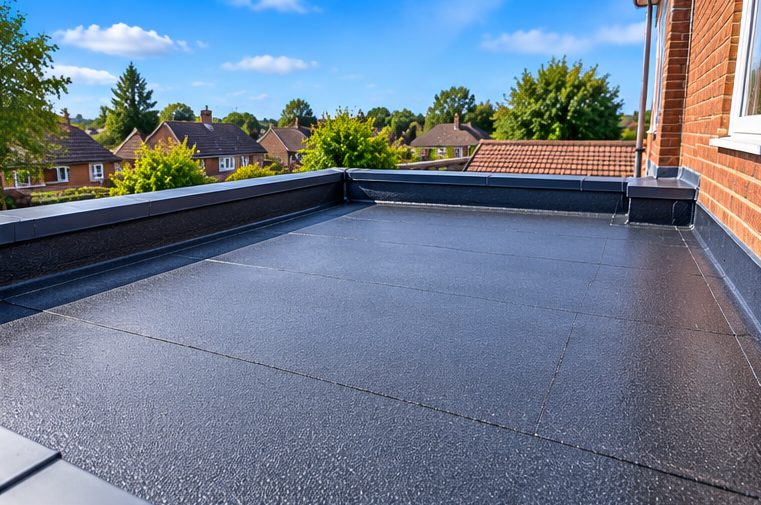
A flat roof is only as good as the layer that keeps the water out. Timber decks, insulation and edge trims all matter, but the top covering does the real work every time it rains. When it splits, blisters or lifts at the edges, the damage tends to spread quickly because flat roofs hold water rather than shedding it.
This guide is about flat roof waterproofing in general terms: the main system types, how they compare, what needs sorting out underneath first, and what to ask before you accept a quote. It is written for Lincolnshire homeowners with a garage, extension, porch or dormer roof that is showing its age.
The first decision is how much of the roof is worth keeping. If the covering is mostly sound and the trouble is one split, a seam or a worn upstand, a local repair may be reasonable. If the surface is crazed, patched many times or soaking wet underneath, adding more layers on top usually just hides the problem. Liquid coatings can extend the life of a covering that is still firmly bonded and dry, but they are not a cure for a rotten deck. A full re-cover means stripping back to the deck, putting right any timber damage, and laying a new system, which is the better route when moisture has got in.
There are three families you will hear about most often, each with honest pros and cons.
Most early failures trace back to what was done before the membrane went down, not the membrane itself. The deck needs to be dry, flat and fixed firmly, with any soft or stained boards cut out and replaced. Falls should let water run to the outlet rather than pond; a small tilt makes a big difference. Edge trims, drip details and upstands against walls need attention at the same time, because the weak point on most roofs is where the surface meets something else. Rushing these stages, or laying over damp, is the surest way to see blisters within a few seasons.
Standing water that is still there a couple of days after rain suggests the falls are poor. Bubbles can mean trapped moisture or air. Cracks along seams, lifted edges and moss in the corners all point to a surface that is beginning to fail. Inside, brown stains on a ceiling or a musty smell in the room below are the signs people usually notice first. Blocked outlets and overflowing gutters make things worse, so keep the surface clear of leaves, and avoid walking on it more than necessary, since foot traffic can damage a tired covering.
Flat roof waterproofing is priced on area, access and condition. A small, simple roof with a dry deck is a different job from a large extension roof with several upstands, roof lights and a leaking outlet. The system you choose changes the labour and materials involved. So does the amount of timber repair needed, whether insulation is being upgraded, and how much edge trim and flashing work is included. Ask for the quote to say what is being removed, what is being replaced and how the details will be finished.
To get a free quotation from F H Roofing, tell us roughly how big the roof is, what it is covered with now, where you have noticed leaks and whether the roof sits over living space. We will talk through the options and arrange a proper look at the roof before recommending a system. We work across Lincolnshire, including around Lincoln, Boston, Sleaford, Grantham, Louth, Skegness, Spalding and Gainsborough, and an honest answer may sometimes be a small repair rather than a new covering.
For flat roof waterproofing anywhere in Lincolnshire, call or WhatsApp 07561 405402, or use the form below and tell us about the job.
Pictures are for illustration purposes only.
See all Flat Roof Repairs services in Lincolnshire →
Only if the surface underneath is sound, dry and well bonded. A coating over trapped moisture or split material rarely holds. It is worth having the roof inspected first so you know whether a coating is sensible or the covering needs replacing.
Soft or spongy areas when the roof is walked on, dark staining on the ceiling below and persistent damp are common signs. The only certain way to know is to open up a section. Avoid walking on the roof yourself; ask a roofer to check.
It often makes sense to look at insulation when the roof is being re-covered, particularly over living space, because the deck is already exposed. Whether it is needed depends on the room below and the build-up. Ask the roofer to explain the options for your roof.
Tell us about the job and we will be in touch.
Prefer to talk? Call 07561 405402 or WhatsApp us.