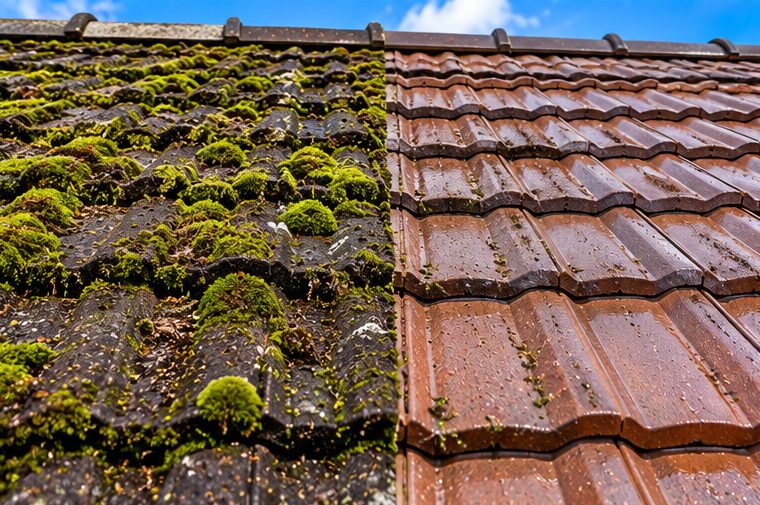
Getting the moss off a roof is only half the job. Once the surface is clean, you can finally see the tiles properly, and the debris that has come down needs somewhere to go. Much of it ends up in the gutters, where it can cause more trouble than it did on the roof.
This guide covers the two follow-up steps that are easy to skip: Roof Tile Inspection After Moss Removal and Gutter Clearing After Moss Removal. It explains what a sensible check looks for, how clearing should be done, and how to judge whether the roof needs repairs, a protective treatment or simply regular attention.
Moss holds moisture against the roof and hides defects underneath it. When it is scraped or brushed away by hand, or treated with a low-pressure or soft-wash method where that suits the roof, the covering is revealed in its true condition. Dislodged material then travels down the slope and collects at the eaves. If it is left in the gutters it packs down, blocks outlets and pushes water over the edge into the fascia and walls. A job that stops at the roof surface leaves the owner with a tidy-looking roof and a gutter problem waiting for the first heavy shower.
With the growth gone, each part of the roof can be looked at properly. A good inspection works methodically across the slopes and along the edges.
Moss, grit from the tile surface and loose granules all find their way into the gutters. Clearing should remove the debris by hand or with a scoop, then flush the run to check water reaches the outlets and flows away. Downpipe tops and the first stretch of drain below are worth checking, since a plug there will bring the whole run back to a standstill. Look at the joints, brackets and the fall at the same time. If the gutter has been overflowing for a while, the fascia and wall behind may already show staining or softness. Doing this on the same visit as the roof clean keeps the job tidy, and it avoids the debris being washed down a second time.
Once the roof is clear and inspected, there are usually three outcomes. The first is that nothing further is needed, apart from regular checks. The second is minor repair, such as replacing a few tiles or re-bedding sections of ridge. The third is a protective treatment to slow regrowth, which can help on shaded or damp roofs, though no one can promise a moss-free surface for a set time. Moss returns wherever light, moisture and organic dust meet a porous roof. Trees nearby, north-facing slopes and poor gutter flow all increase the chances. Ask for the inspection findings explained plainly, so you can choose what is worth doing.
The extent of moss, the roof size and pitch, and the height of the building all affect the effort. Access is a big factor: a low bungalow roof is a different task to a steep three-storey elevation needing scaffold or a tower. The type of covering matters, because old, soft or fragile tiles must be treated more carefully. Gutter length, how full they are and how many downpipes are involved add time, as do any repairs found along the way. A good quote separates the moss removal, the gutter clearing and any optional repairs or treatment, so you can see exactly what is included.
If your roof has recently been cleaned, or you are planning to have it done, we can inspect the tiles and clear the gutters across Lincolnshire, including around Lincoln, Boston, Louth and Skegness. Tell us the type of property, how much moss there is and whether the gutters overflow. We will explain what we find and what, if anything, is worth doing next, with no pressure. Use the call or WhatsApp buttons on this page to ask for a free quotation.
For roof tile inspection and gutter clearing after moss removal anywhere in Lincolnshire, call or WhatsApp 07561 405402, or use the form below and tell us about the job.
Pictures are for illustration purposes only.
See all Roof Moss Removal services in Lincolnshire →
Yes, it makes sense. Removed moss and loose debris collect in the gutters, so clearing them during the same visit stops blockages forming and lets you check the outlets, joints and brackets while access is already in place.
It can. Once the growth is gone you can spot cracked or slipped tiles, tired ridge mortar and worn flashings that were not visible before. Finding them early usually means smaller repairs than waiting for a leak to appear.
It may, especially on shaded, damp or north-facing slopes. Nobody can promise a moss-free roof for a set time. Regular checks, clear gutters and, where suitable, a protective treatment can slow regrowth.
Tell us about the job and we will be in touch.
Prefer to talk? Call 07561 405402 or WhatsApp us.