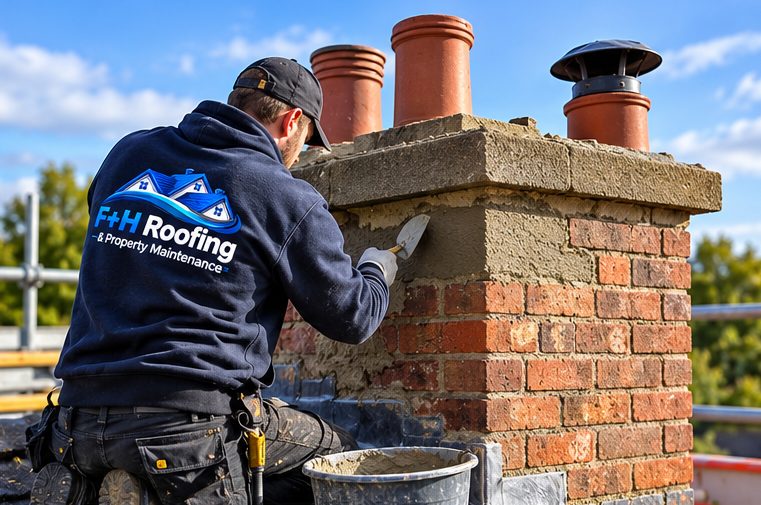
Most chimney stacks are the most exposed part of a house. They stand clear of the roof, take the full force of wind and rain from every side, and are rarely looked at by the people living underneath them. Across Lincolnshire, where open farmland and flat ground leave little shelter, a stack on a Victorian terrace in Lincoln or a farmhouse out beyond Louth gets a hard time through the winter.
This guide explains what chimney stack repairs usually involve, how to tell a small fix from a bigger restoration job, and what to have sorted before anyone climbs a ladder. It is general advice from a roofing point of view. It cannot replace someone looking at your stack properly, and we would always suggest a proper inspection before any decision is made.
Many problems can be spotted from the garden with a pair of binoculars, or from inside the loft with a torch. You do not need to be a builder to notice that something has changed. Look for the following and write down what you see, with the date, so a roofer can judge how quickly it is developing.
Chimney Stack Repairs cover a wide range, from an afternoon's work to several days. The common jobs are repointing failed mortar, replacing individual bricks, reforming the cement crown that holds the pots in place, renewing flashings where the stack meets the roof, and re-bedding or replacing pots. Each one is a small job on paper, but they all depend on safe access and a sound base to work from. Mortar is usually raked out and replaced to a sensible depth rather than smeared over, because a surface skim looks fine for a season and then falls off. Where a brick has failed, a matching replacement is cut in rather than patched. Where a stack is leaning or the brickwork is loose throughout, repair may not be the right answer, and rebuilding part of it is a more honest option.
Chimney Restoration is the term we use when the stack as a whole needs bringing back, not just one weak spot. That might mean repointing the whole stack, replacing a number of bricks, treating or repairing render, renewing the crown and flashings, and fitting new pots or a cowl in one visit. On older properties it often makes sense to do the lot together, because the scaffold or access equipment is the awkward part and paying for it twice is wasteful. Restoration also gives the chance to match the look of the original brickwork and to deal with the cause of the damage, such as a failed flashing letting water in behind the stack, rather than just the symptoms. If a stack is no longer in use, it is worth discussing whether it needs to stay at all.
The most frequent trouble comes from quick fixes. Smearing sealant over open joints, painting masonry paint over damp brick, or using a hard cement mortar on soft old bricks can trap moisture and speed up the damage. Another mistake is dealing with a leak at the ceiling and never looking up at the source. A stack that is losing water will keep doing so, and the timber around the chimney breast suffers quietly. Finally, be wary of anyone who offers to repair a stack without access to the whole of it. Looking at the top from a distance does not show the condition of the lower courses, the back face or the junction with the roof. A decent inspection should cover all four sides.
No honest roofer can price a chimney by phone, because the effort depends on things you cannot see from the ground. The main drivers are how high and how awkward the stack is to reach, whether scaffolding or a tower is needed, how much brickwork is affected, and whether the problem is one defect or several. The condition of the mortar and bricks, the number of pots, the state of the lead work and any render all change the scope. The weather and the season can affect timing too, though not the quality of the work. A written quotation should say plainly what is included, so you can compare like with like if you get more than one. Ask what happens if hidden damage turns up once the work starts.
If you are in Lincolnshire and want a second pair of eyes on your stack, get in touch with F H Roofing for a free quotation. It helps to tell us the type of house, roughly how old it is, and what you have noticed, whether that is crumbling mortar, a stain on the chimney breast, or something that came down in the last gale. Photos taken from the ground or from a safe upstairs window are useful, though they are no substitute for a visit. We will explain what we find in plain terms, and if the stack needs nothing more than watching, we will say so. For urgent problems after a storm, our 24-hour emergency call-out is available.
For chimney stack repairs and restoration anywhere in Lincolnshire, call or WhatsApp 07561 405402, or use the form below and tell us about the job.
Pictures are for illustration purposes only.
See all Chimney Repairs services in Lincolnshire →
A repair deals with one or two defects, such as a patch of failed mortar or a cracked crown. Chimney Restoration is for stacks where the brickwork, mortar, flashings and pots are all tired at once. Only a close inspection can tell which applies, so ask for one before deciding.
It can be. A stack that leans or has loose courses may drop bricks onto the roof or the ground below, so keep people away from underneath it and arrange an inspection soon. Do not climb up to test it yourself. It may need partial rebuilding rather than a repair.
Small checks from the ground are sensible, but the repair work itself involves working at height on a steep, exposed structure. Falls from roofs are a serious risk, and poor mortar choices can cause more damage. It is usually safer and cheaper in the long run to have a roofer do it.
Tell us about the job and we will be in touch.
Prefer to talk? Call 07561 405402 or WhatsApp us.