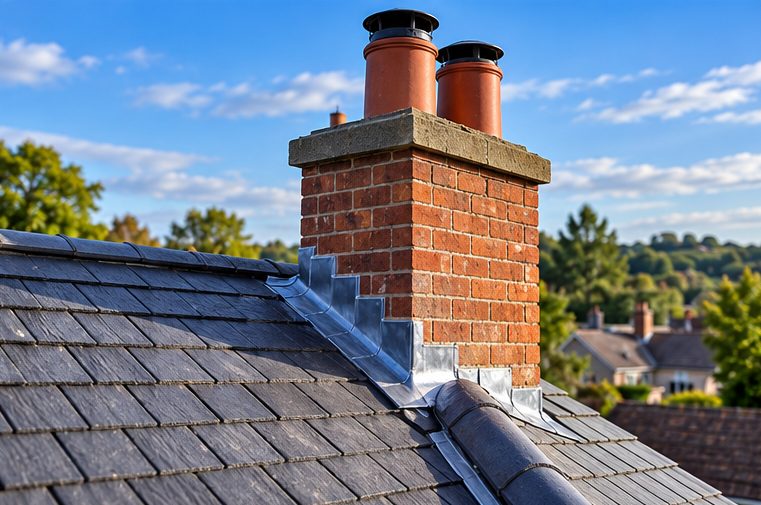
The top of a chimney stack takes more weather than almost any other part of a house. Rain, frost, wind and sun all work on a small patch of mortar that holds the pots in place and sheds water away from the brickwork. When that mortar cracks, the damp it lets in often shows up months later as stained ceilings or crumbling brick lower down.
This guide explains how chimney flaunching repairs and chimney crown repairs differ, how to spot trouble from the ground, and what a sensible repair involves. It is general advice for Lincolnshire homeowners, not a diagnosis of your own stack. Only a proper look at the stack itself will tell you what it needs.
Flaunching is the sloping mortar bed around the base of the pots. It holds them upright and throws rainwater outwards, away from the flues. A chimney crown, sometimes called a chimney cap, is the slab or sloping mortar layer across the whole top of the stack, usually with the pots sitting in or on it. Older stacks tend to have a flaunching bed only, while many later ones have a concrete or cement crown with an overhang that sheds water clear of the walls. The two jobs overlap, which is why people use the terms loosely. The key point is that both are there to keep water out of the flues and the brickwork, and both are exposed to harsh conditions all year.
Most of the evidence can be seen safely from the ground or from a window, ideally with binoculars. Look for the following.
Where the damage is limited, chimney flaunching repairs mean chipping out the cracked or hollow mortar, checking the pots are still sound, and bedding them again in a fresh, well-compacted mix shaped to fall away from each flue. Where a crown has failed more widely, chimney crown repairs may involve breaking off the old layer and forming a new one with a slight overhang and a drip edge. The work needs safe access, so a ladder, a roof ladder or scaffold towers may be needed depending on the height and the roof pitch. Weather matters too, because fresh mortar should not be laid in frost or heavy rain.
The commonest mistake is smearing new mortar over old cracked material. It looks tidy for a season, then the bond fails and water gets underneath. Another is making the flaunching too thin at the edges, where it breaks away first. Mixes that are too wet or too weak also crack quickly. A repair should also not seal the flue tops so tightly that ventilation is lost; flues that are in use or capped need appropriate venting. Finally, patching the top while ignoring crumbling brickwork or a failed flashing below only moves the leak somewhere else, so the whole stack deserves a look.
Chimney work is priced on the access and the condition, not just the size of the patch. A single-pot stack on a low, easy roof is very different from a tall multi-pot stack on a steep pitch. The number of pots, whether the pots themselves need replacing, the state of the brickwork beneath, and whether scaffold or a tower is needed all change the quote. So does the question of whether the crown can be repaired or must be rebuilt. A quote that describes exactly what is being removed and replaced is easier to compare than a single line saying chimney repair.
If you can see cracks, loose pots or damp below the stack, get in touch with F H Roofing for a free quotation. It helps to tell us how many pots there are, how high the stack is, whether you have seen water inside, and any photos you have taken from the ground. We will talk through what the repair is likely to involve and arrange a proper inspection before anything is agreed. We cover Lincoln, Boston, Sleaford, Grantham, Louth, Skegness, Spalding, Gainsborough and the villages in between.
For chimney flaunching and crown repairs anywhere in Lincolnshire, call or WhatsApp 07561 405402, or use the form below and tell us about the job.
Pictures are for illustration purposes only.
See all Chimney Repairs services in Lincolnshire →
It depends on the quality of the mix, the weather exposure and the condition of the stack beneath. A well-formed crown with a proper overhang can last many years, but exposed stacks age faster. Regular checks from the ground help you catch small cracks before they let water in.
Often you can see warning signs from the ground, such as visible cracks, mortar in the gutters or leaning pots. Never climb onto a roof to check. A roofer can inspect safely and tell you whether a small repair will do or the crown needs more work.
No. Damp can also come from failed flashings, cracked pointing, blocked or uncapped flues or condensation. The crown is a common cause because it is so exposed, but a proper inspection should look at the whole stack before the repair is decided.
Tell us about the job and we will be in touch.
Prefer to talk? Call 07561 405402 or WhatsApp us.