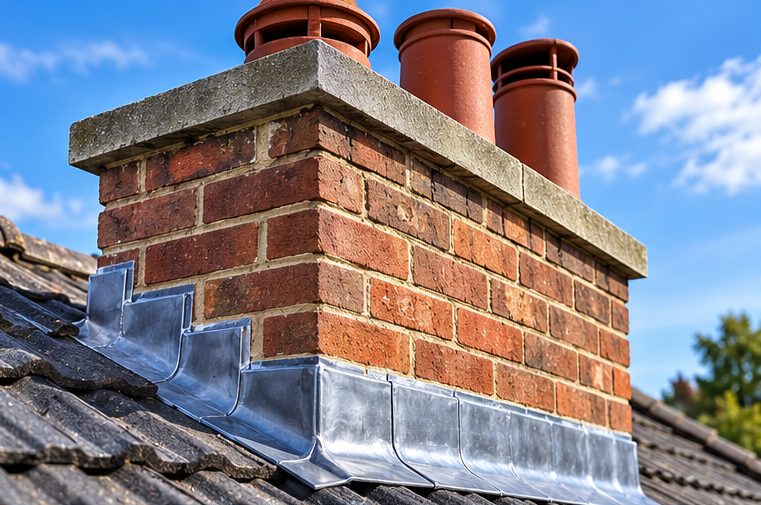
Where a chimney stack passes through your roof, the joint between brickwork and tiles is sealed by strips of lead. That seal is called flashing, and it is one of the most common places for a roof to start letting water in. A damp patch on a chimney breast or a brown stain on an upstairs ceiling often traces back to it.
This guide explains how chimney lead flashing is put together, how to spot trouble from the ground, and how to decide between chimney lead flashing repairs and a full replacement. It is written for Lincolnshire homeowners, and it is general guidance rather than a diagnosis. Any roof is judged properly only by someone standing on it.
A properly detailed chimney flashing is not a single strip. Lead is cut into several pieces that work together. A front apron sits over the tiles below the stack, step flashings run up the sides and are tucked into the mortar joints as the brickwork rises, and a back gutter channels water round the stack on the uphill side. Between them, soakers or separate cover pieces tie the lead into the roof covering. Each piece overlaps the next so water is led down and away rather than into the joint. The upper edge of the lead is usually set into a chased groove in the brickwork and sealed with mortar or a sealant. When all of this is done well, the joint can last for decades. When any one piece is missing, short or poorly fixed, the water finds it.
You can learn a lot from the ground and from inside the house. Look for these:
Chimney lead flashing repairs make sense when the lead itself is sound and the problem is local: a section pulled out of the mortar, a failed joint, or a small split. Re-fixing, re-pointing the chase and renewing a short length can be enough. Replacement is the better route when the lead is thin, cracked in several places, wrinkled from years of heat movement, or when earlier sealant patching has covered up the real fault. Chimney lead flashing replacement also tends to be sensible when the surrounding tiles or the stack pointing need work, because the lead has to be lifted anyway. Putting old lead back under fresh work rarely pays. A roofer can only tell which applies after inspecting the lead up close, preferably from a safe working platform rather than a ladder.
The sequence is fairly consistent. Access comes first, which may mean ladders, a roof ladder or scaffolding depending on the height and pitch. The old lead is removed and the substrate checked for damp or rot. Mortar joints that will hold the new lead are raked out to a consistent depth. New lead is then cut, dressed and fixed piece by piece, working from the bottom upwards so each piece laps the one below. The upper edges are wedged into the chase and re-pointed. Finally the area is cleaned up and checked. Because lead is soft, it needs to be dressed carefully into the tile profile, and it should be allowed to move with temperature rather than being clamped rigidly. Rushed work in this area is the usual reason for repeat leaks.
No two chimneys are the same, so a sensible quote follows what the roofer actually finds. The main drivers are the size of the stack and how many sides need flashing, the height and pitch of the roof, and how easily the work can be reached. If scaffolding is needed, that adds to the job. The condition of the brickwork and mortar matters, as does whether tiles must be lifted and relaid. Hidden problems such as damp timber around the stack can change the scope, which is why a firm figure given over the phone without a look is worth treating with caution. Ask what is included, whether re-pointing is part of the price, and how the lead will be fixed.
If you suspect your chimney flashing is letting water in, the first step is a proper inspection. F H Roofing is based in Beckingham near Lincoln and works across Lincolnshire, and we offer free quotations for flashing work. Tell us what you have noticed and where, roughly how high the stack is, and whether the house is one storey or more. Photos taken safely from the ground help us plan. We will explain what we find, say whether repair or replacement looks sensible, and leave the decision with you. We do not claim to be structural engineers; if a stack looks unstable, we will tell you plainly and suggest the right next step.
For chimney lead flashing repairs and replacement anywhere in Lincolnshire, call or WhatsApp 07561 405402, or use the form below and tell us about the job.
Pictures are for illustration purposes only.
See all Chimney Repairs services in Lincolnshire →
Sealant is sometimes used as a short-term measure, but it hardens, cracks and peels as the lead and brickwork move. It can also hide a deeper fault while water keeps getting in behind it. Treat it as temporary, and have the flashing looked at properly.
Well-fitted lead can last a very long time, but it depends on the thickness, the quality of the fixing, the exposure of the roof and how well the stack is maintained. Movement and failed pointing usually cause problems before the lead itself wears out.
Often only a few tiles next to the stack are lifted so the new lead can be tied in, then relaid. If the surrounding tiles are damaged, or damp is found underneath, the area of work can grow. We would explain this before starting.
Tell us about the job and we will be in touch.
Prefer to talk? Call 07561 405402 or WhatsApp us.