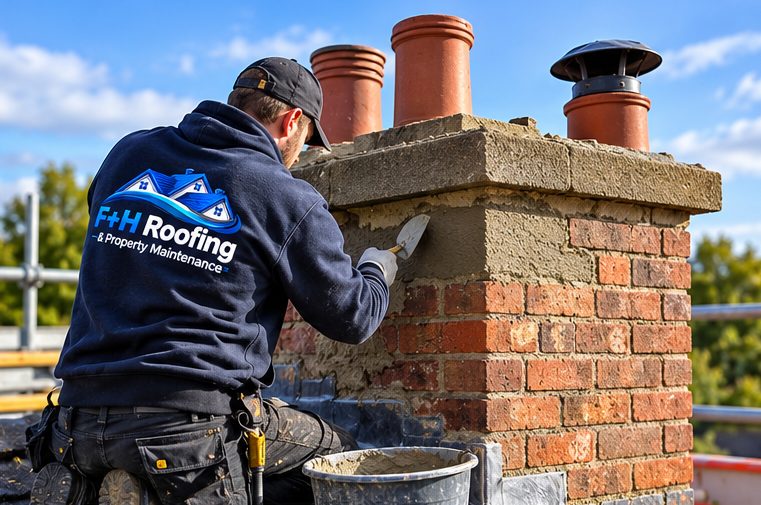
A chimney stack takes more weather than almost any other part of a house. It stands proud of the roof, faces the wind from every side and gets soaked, frozen and dried out again through the year. Because it sits high up, most owners only notice a problem when a stain appears on a bedroom ceiling or a piece of debris lands in the garden.
This guide explains what chimney inspections cover, what a roofer can and cannot judge from the roof, and which signs mean it is time to book one. It is written for homeowners across Lincolnshire, from Lincoln and Sleaford to Boston and Skegness, where open, exposed positions can make stacks work hard.
Chimney faults tend to build slowly and out of sight. Mortar joints soften a little each winter, a cracked flaunching lets in a trickle of water, and a lead flashing lifts at one corner. None of this shows from the garden path. By the time damp marks show indoors, the water may have been working its way in for a long time. A planned look at the stack is cheaper in effort and disruption than reacting to a leak, and it gives you a clear picture of what is sound and what needs attention. It is also sensible after a stormy spell, after scaffolding has been up for other work, or when you are buying or selling a property and want to know the condition of the roof line.
A roofer working at height can look closely at the visible parts of the stack and the junction with the roof. Typical checks include:
It helps to be clear about limits. A visual inspection tells you the condition of what can be seen and reached. It does not replace specialist checks inside the flue. If you use the fireplace or a stove, the flue itself is a separate matter and is usually looked at by a sweep or a flue specialist, not a roofer. Likewise, if a stack looks seriously out of true, or you suspect a structural problem in the house, it is sensible to involve the right professional rather than rely on a roofer's opinion alone. We describe repairs in general terms and will say plainly when something is beyond a simple inspection and needs a second opinion.
Do not wait for a routine date if you notice any of these:
An inspection is usually a modest job compared with the repair work that might follow, and what drives the effort is mainly access. A stack on a low single-storey roof with a clear approach is simpler than one rising from a steep, high ridge with no safe standing point. The height, the pitch, whether scaffolding or a tower is needed, and how many stacks there are all matter. If repairs follow, the scope depends on what is found: repointing a few joints is different from rebuilding the top courses. We do not quote figures without seeing the property, and we would rather explain the findings first so you can decide what to do and in what order.
To arrange chimney inspections, get in touch through the buttons on this page by phone or WhatsApp. Tell us roughly where the property is, how many chimneys there are and whether you have seen any staining or falling debris. If you can describe what you see from the ground, that helps us plan the visit. We will talk through what we find, explain which items are urgent and which can wait, and give you a free quotation for any repair work. There is no pressure to go ahead, and you are welcome to ask questions about anything you do not follow.
For chimney inspections anywhere in Lincolnshire, call or WhatsApp 07561 405402, or use the form below and tell us about the job.
Pictures are for illustration purposes only.
See all Chimney Repairs services in Lincolnshire →
There is no single rule, but a look every few years is sensible, plus after severe weather or if you spot staining, loose debris or damp near the chimney breast. Exposed stacks and older brickwork may benefit from checking a little more often.
No. A roofer can inspect the stack, pots, flashings and flaunching from outside, but the condition of the flue lining is a separate matter. If you light fires or run a stove, ask a sweep or flue specialist to assess the flue itself.
Not always. Many stacks can be checked using roof ladders or a tower, depending on height and pitch. Scaffolding becomes more likely if repairs are needed, and we can explain what access the job really requires when we visit.
Tell us about the job and we will be in touch.
Prefer to talk? Call 07561 405402 or WhatsApp us.