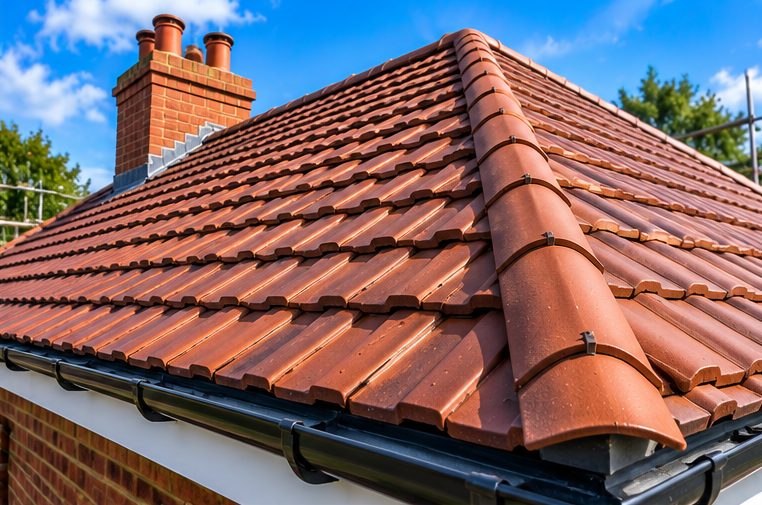
Tiles and slates get all the attention, but they are only the visible layer. Underneath sits a set of parts that do much of the real work: the battens that hold the tiles, the membrane that catches water that gets past them, and the underlay that lets the roof space breathe. If these fail, the roof fails, however good the tiles look.
Most homeowners first meet this subject when a re-roof is being planned, or when a roofer lifts a few tiles and finds something unexpected. This guide explains what each layer does, how to tell when it needs attention, what replacement involves, and what to look for in a quotation for work on a Lincolnshire home.
Think of the roof as a series of defences. Rafters carry the load. Battens, thin lengths of timber fixed across the rafters, give the tiles or slates something to hang from at the correct spacing. Over the rafters, beneath the battens, runs the membrane or underlay. Its job is to shed wind-driven rain and snow that blows under the tiles, and to stop dust and draughts. Older houses often have no underlay at all, or a stiff bitumen felt that has cracked with age. Modern breathable underlay lets moisture vapour from the house escape through it, which helps keep the roof timbers drier. Each layer depends on the others. Good tiles on rotten battens will slip. Sound battens under a torn membrane will let water into the loft. Replacing one without looking at the others is a common false economy.
Battens are hidden, so the signs are often indirect. Tiles that slip repeatedly or sit unevenly may be on weak battens. A roof that sags between rafters, or tiles that are loose when touched, is worth investigating. In the loft, look for daylight, damp timber, crumbling wood or nail heads that have rusted through. Roof batten replacement becomes necessary when the timber is rotten, split, woodworm-damaged or too narrow to hold fixings, which is common on older roofs. Often the problem only shows once the tiles are stripped. Usually when a roof is fully re-tiled, new treated battens are fitted as a matter of course, since reusing old ones undermines the new covering. When only a section of tiles is being repaired, a roofer can sometimes replace individual battens, though if many are poor it points to a bigger job.
Roofing membrane installation means laying the sheet across the rafters, with overlaps and fixings set out so water runs down and out rather than in. It must be supported correctly, tucked into the gutter line and sealed around chimneys, roof windows such as a Velux and any pipes. Breathable roof underlay installation follows the same pattern but uses a vapour-permeable product, which lets moist air out of the loft without letting liquid water in. This matters in modern, well-sealed houses where everyday cooking, washing and breathing add a lot of moisture. Whether you need a breathable type depends on the roof, the loft insulation and the ventilation, so ask your roofer to explain the choice for your property. Underlay is not a replacement for ventilation, and a roof that was damp before may need vents added at the eaves or ridge as well.
The sensible moment to renew all three layers is when the tiles come off. The whole process usually runs in order, and homeowners find it easier to follow knowing the sequence:
The cost of battens, membrane and underlay work depends on roof area, pitch and complexity. Hips, valleys, dormers, roof windows and chimneys all need extra cutting and sealing. Scaffolding is a significant part of the job on most houses and should be shown clearly in the quotation. The condition of the rafters and the amount of timber that needs replacing is the main unknown, and a good roofer will explain how any extra timber would be dealt with before work begins, rather than surprising you afterwards. The choice between a standard and a breathable underlay, and whether new ventilation is added, will also change the scope. Ask for the specification written down, including the type of batten, treatment and underlay, so you can compare quotes properly.
If your roof is due work in Lincoln, Boston, Grantham, Spalding or elsewhere in Lincolnshire, ask us for a free quotation. We will look at the roof and the loft where possible, explain what we find under the tiles, and set out whether roof batten replacement, a new membrane, breathable underlay or all three make sense. Tell us about any leaks, sagging, draughts or condensation in the loft, and mention if you are also thinking about new roof windows or insulation. Knowing the full picture makes the quotation more accurate and avoids doing the job twice.
For roof battens, membranes and breathable underlay anywhere in Lincolnshire, call or WhatsApp 07561 405402, or use the form below and tell us about the job.
Pictures are for illustration purposes only.
See all New Roof Installations services in Lincolnshire →
Usually it is sensible, because old battens have often weakened and cannot hold new fixings reliably. Sound, treated battens can occasionally be kept, but only after inspection. A roofer should be able to show you the condition of what is there.
Not always, but it is common on modern re-roofs because it helps moisture escape. The right choice depends on your loft, insulation and ventilation. Ask your roofer to explain why they suggest a particular type for your house.
In most cases no, because the underlay sits beneath the battens. Fitting it properly means stripping the tiles or slates. Some repairs can add a patch locally, but a proper membrane normally goes in during a re-roof.
Tell us about the job and we will be in touch.
Prefer to talk? Call 07561 405402 or WhatsApp us.