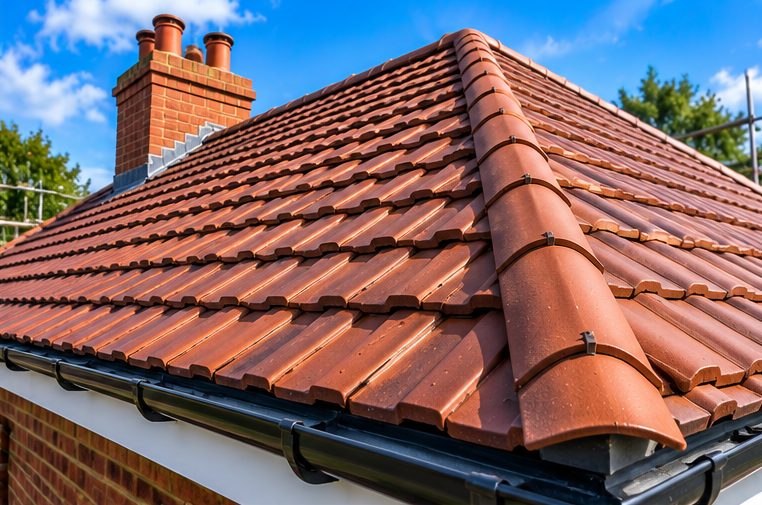
Clay has been used to cover roofs in this country for centuries, and a well-laid plain tile roof still gives a house a distinctive, slightly textured look that other materials struggle to copy. If you are planning a new roof, an extension or a full re-roof, it is worth understanding what you are choosing. This guide explains Clay Tile Roofing in practical terms, rather than by catalogue.
Plain tiles are small, laid in overlapping courses, and they suit steeper pitches and period-style houses, though they can also be used on new builds. A Plain Tile Roof Installation is more labour-heavy than a large-format tile, and that shapes the cost and the timescale. Below are the things to weigh up, from structure and detailing to upkeep, followed by how to ask F H Roofing for a free quotation.
Clay tiles are fired from natural clay, so their colour comes from the material and the firing rather than a surface coating. They tend to weather gracefully, softening with age rather than fading in an obvious way. Plain tiles are small and flat or slightly curved, and each course overlaps the one below, usually fixed with nibs that hook over battens and nails at intervals. Because there are many tiles per square metre, the roof has a fine grain that suits cottages, terraces and traditional brick houses. They are also usually a good fit where the planners or neighbours expect a traditional appearance.
Plain tiles generally need a steeper pitch than large concrete tiles, because water has to run off quickly down the many overlaps. Check the existing rafters, the spacing of the timbers and the condition of the wall plates before agreeing to a change of covering. Clay is heavier than some modern alternatives, and a roof designed for lightweight sheets or slates may need to be strengthened. A roofer should look at the structure in the loft, not just the outside. Where you are extending or building new, the roof design can be set up for tiles from the start, which is easier than adapting an existing frame.
The sequence matters because each layer protects the one beneath it.
The tile itself is often the least likely part to fail; the weak points are usually flashings, valleys, nails and underlay. Stainless or otherwise corrosion-resistant fixings, well-dressed lead at chimneys and walls, and enough ventilation in the roof void make a real difference to the working life. Roof windows, including a Velux, need proper trimming and flashing kits so the tiling can be neatly cut around them. Hand-finished hips and valleys are slower than dry-fit trims, which is something to discuss. Ask how the eaves, verges and abutments will be detailed, as those are where leaks tend to appear.
Plain tiles take more time to lay than larger tiles, so labour is a bigger share of the job. Beyond that, the roof area, the pitch and the number of hips, valleys, dormers and chimneys all affect the amount of cutting and fitting. Scaffolding is a significant part of most re-roofs, and the quote should say whether it is included. Any timber repairs, new battens, insulation, ventilation or rooflights add to the specification. Reclaimed and new tiles also differ in how consistent they are, which can affect both appearance and the sorting time needed.
F H Roofing works across Lincolnshire, including around Grantham, Louth and Lincoln, and you can request a free quotation for a clay or plain tile roof. Have the age and type of the house to hand, tell us whether it is a re-roof, extension or new build, and mention any planning or conservation constraints you know about. A site visit lets us look at the structure in the loft, measure up properly and put the options in writing so that you can make a calm decision.
For clay tile and plain tile roofing anywhere in Lincolnshire, call or WhatsApp 07561 405402, or use the form below and tell us about the job.
Pictures are for illustration purposes only.
See all New Roof Installations services in Lincolnshire →
Not always. They need a roof structure that can carry the weight, and plain tiles need a steep enough pitch. A roofer should inspect the rafters and pitch, and may suggest a different tile where the structure or the budget does not suit clay.
Usually not a great deal. Check for slipped or cracked tiles after storms, keep gutters clear and look at the flashings and ridge now and then. Moss may collect on shaded slopes and can be cleaned off by hand.
Yes, a roof window such as a Velux can be fitted into a tiled roof. The rafters are trimmed and a flashing kit is used so the tiles seal neatly around it. It is easiest to plan this at the same time as the re-roof.
Tell us about the job and we will be in touch.
Prefer to talk? Call 07561 405402 or WhatsApp us.