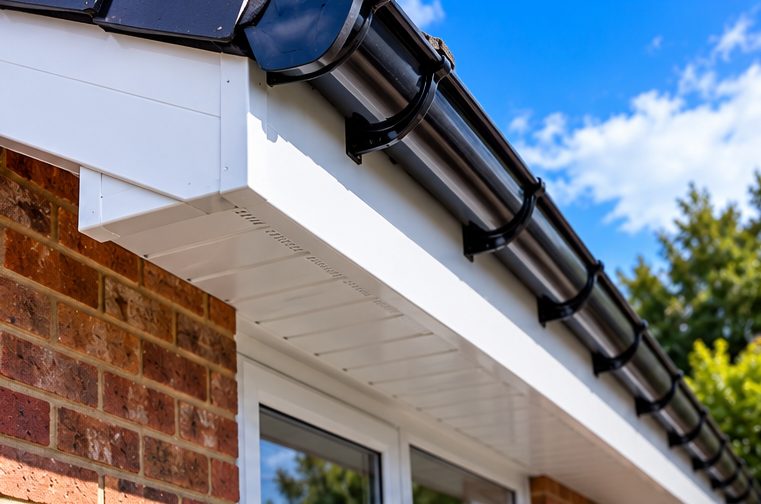
Most gutter leaks do not happen along the length of the gutter. They happen at the joints, where one section meets the next and a rubber seal slowly hardens, shifts or collects grit. Seamless guttering tries to remove most of those weak points by using continuous lengths made to suit each run of your roofline.
That sounds like an easy win, but it is not the right answer for every property. This guide explains how seamless guttering works, how it compares with the usual sectional UPVC system, and what to think about before you ask for a quote anywhere in Lincolnshire.
Standard guttering comes in short lengths that clip together with joint brackets and seals. Seamless guttering is formed to the length of each run, so a long front elevation may have no joints along it at all. Joints remain where the gutter turns a corner, meets a stop end, or connects to a downpipe outlet, so the system is better described as having far fewer joints rather than none. The gutter is shaped and cut to fit the actual measurements of your house, which is why a measured survey comes first. If you are interested, ask us whether it suits your property, because access, the length of each run and the state of the fascia all influence the answer.
Sectional UPVC guttering is the familiar choice. It is light, available in black and white as well as other colours, easy to repair in small pieces and a sensible option for most houses. Its weak point is the joints, which can drip when seals age or when the gutter has sagged and the fall has gone. Seamless systems reduce that risk on long runs, and a continuous profile can look tidier from the road. The trade-off is that a damaged section can be harder to repair neatly, and shaping long lengths on or near site needs space and a dry working area. Neither type fixes a poorly supported or badly aligned run, so the fascia and brackets matter more than the label.
Gutters hang from the fascia board or from brackets fixed to the rafters, so anything weak behind them will pull the new system out of line. Before ordering new guttering, look for soft or flaking timber, gaps at the joints between boards and daylight at the eaves. Rotten fascia needs replacing first, otherwise a new gutter will sag within a couple of winters. This is also the moment to think about the full roofline. If the soffit and fascia are tired, fitting everything together tends to be tidier and avoids taking scaffolding down only to put it up again. A sound, straight fascia is what lets a continuous gutter keep its fall to the outlet.
Any gutter works only if water can run to the outlet. A slight, consistent fall is needed along every run, and the number and position of downpipes should suit the roof area draining into them. Long, uninterrupted runs on a large roof can overload a single outlet, so a surveyor should consider extra downpipes. In Lincolnshire, where many roofs are exposed to open, flat countryside and wind-driven rain, secure brackets at sensible spacing are worth insisting on. Debris still gathers, so seamless does not mean maintenance-free. Plan to clear leaves and silt at least once a year, and after storms, so the water does not overflow behind the gutter and soak the fascia.
The main drivers are the total length of guttering, the number of corners and downpipes, and the height of the house, since access equipment is a large part of the work on taller buildings. The condition of the fascia and soffit can add scope. Removing and disposing of the old gutters is part of the job, and the colour and profile you choose may change how the system is made. Properties with complicated rooflines, such as bays or dormers, take longer to measure and fit. We will not guess at a figure over the phone. A visit lets us measure and explain what is included, and we are happy to quote for seamless and sectional systems so you can compare.
F H Roofing is based in Beckingham near Lincoln and works across Lincolnshire, including Louth, Boston and Grantham. Use the phone or WhatsApp buttons on this page to get in touch. It helps to tell us whether the house is a bungalow, two-storey or larger, which colour you are considering, and what is wrong with the current gutters, such as dripping joints, overflowing corners or sagging sections. Photos of the eaves are useful. We will arrange a free quotation, check the fascia while we are there and give you a straight answer about whether seamless guttering is a sensible choice for your property.
For seamless guttering anywhere in Lincolnshire, call or WhatsApp 07561 405402, or use the form below and tell us about the job.
Pictures are for illustration purposes only.
See all Fascias & Guttering services in Lincolnshire →
Not exactly. Sectional UPVC is made in short lengths that join together, while seamless guttering is formed in continuous lengths for each run. Both can be used on a roofline with UPVC fascias. Ask us which suits your property and how each would be fitted.
It can, though usually at corners, outlets and stop ends rather than along the length. Poor fall, weak brackets or blockages cause overflow too. A well-supported run with correctly placed outlets matters as much as having fewer joints.
Only if the boards are sound and straight. Soft, split or sagging fascia will not hold brackets properly, and the new gutter will lose its fall. It is usually wiser to repair or replace the fascia first, and we can check it during the visit.
Tell us about the job and we will be in touch.
Prefer to talk? Call 07561 405402 or WhatsApp us.