Most people only think about their gutters when water starts pouring over the edge during heavy rain, or when a green streak appears down the wall. By then, the blockage has usually been building for months. Leaves, moss washed off the roof, seeds, and the odd tennis ball all end up in the same place.
This guide covers why gutters block, how to tell whether you need Gutter Cleaning or something more involved, and what a proper clearance should include. It is aimed at Lincolnshire homeowners with UPVC systems, which is what most houses in the county now have, and it explains where a simple clear-out stops and a repair begins.
Gutters are narrow channels with a gentle fall towards the outlet, so anything that collects in them tends to stay. Trees nearby are the obvious cause, but they are not the only one. Roof tiles shed moss and grit, particularly on older roofs, and that mixes with leaf mould into a dense sludge. Birds nest in them, and wind blows in debris from open land. Flat, open areas of Lincolnshire can be breezy, which does not help. Downpipes can also clog at the top or in the bends, even when the horizontal run looks fine. Once a few centimetres of debris build up, plants may even start growing in it, and the added weight can pull a bracket loose.
Watch for the following, ideally when it is raining:
Blocked Gutter Clearance should be more than a quick scoop from a ladder. The debris is removed by hand along the full run and bagged up rather than dropped into the garden. The outlets and downpipes are then checked, and water is run through to confirm the flow is clear. This also shows up leaking joints, loose brackets and sections that hold water because the fall has slipped. Working from a stable platform or a tower matters, since reaching sideways from the top of a ladder is a common cause of accidents. If your guttering is high, or sits over a conservatory or a lean-to, it is worth having a professional do it rather than risk it yourself.
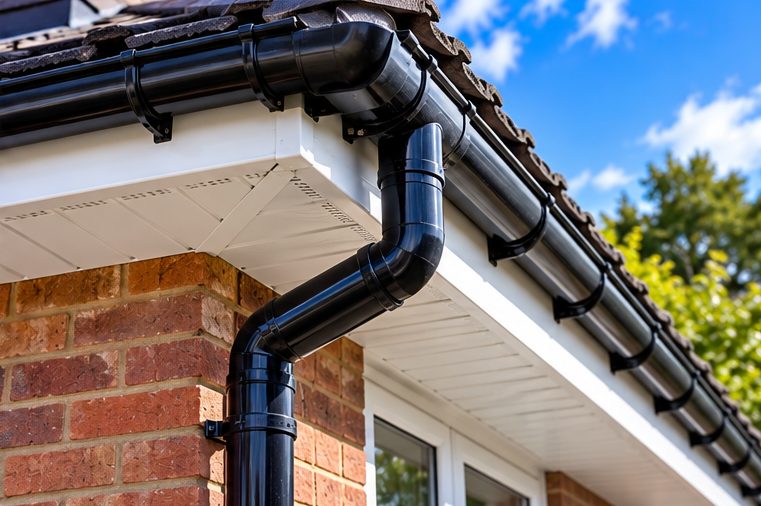
Most domestic systems are UPVC, which does not rust and is easy to wipe down. Black and white are the usual colours, and cleaning can restore their appearance, as the inside often looks much worse than the outside. If the same gutters keep blocking or leaking at joints, you might ask about seamless guttering, where continuous lengths are formed for the run so there are fewer joints. Ask us whether it suits your property, because it depends on the length of each run and the layout of the house. Deeper channels are another route for roofs that shed a lot of water. Whatever you choose, regular clearing is still needed, because no gutter can cope with a build-up of debris.
Clearance is priced according to how long the work takes and how safely it can be reached. The length of guttering, the number of downpipes, the height of the building and whether it is a bungalow or a three-storey house all matter. Heavy build-up, wet sludge and moss take longer than a light layer of leaves. Access is the biggest variable: a tower or scaffolding is sometimes needed for tall or awkward walls, and extensions or conservatories can limit where ladders can stand. If we find repairs are needed, such as re-seating a joint or refixing a bracket, those are described separately so you can decide. It is also worth asking whether the downpipes are included.
F H Roofing is based in Beckingham near Lincoln and works across Lincolnshire, and we provide free quotations for gutter work. Let us know the type of property, roughly how many sides have guttering, and what you have noticed, such as overflow, drips or sagging. Photos of the problem areas help. We will tell you whether a clearance is enough, or whether a repair or replacement would be more sensible, and we will keep the options separate. If you want a regular schedule, say so, and we can talk through what suits your trees and roof.
For gutter cleaning and blocked gutter clearance anywhere in Lincolnshire, call or WhatsApp 07561 405402, or use the form below and tell us about the job.
Pictures are for illustration purposes only.
See all Fascias & Guttering services in Lincolnshire →
Once or twice a year is a common rule of thumb, usually in autumn and late spring. Homes near trees, or with mossy roofs, may need it more often. It depends on your surroundings, so look after a heavy storm too.
Low single-storey gutters can be done by a careful homeowner with a stable ladder and gloves. Anything higher is better left to someone with proper access equipment, as falls from ladders are a real risk and blocked downpipes need checking.
Cleaning stops overflow caused by debris, but it will not fix a cracked joint, split section or loose bracket. We check for these while clearing and tell you if repairs would be sensible, so you only pay for what is needed.
Tell us about the job and we will be in touch.
Prefer to talk? Call 07561 405402 or WhatsApp us.