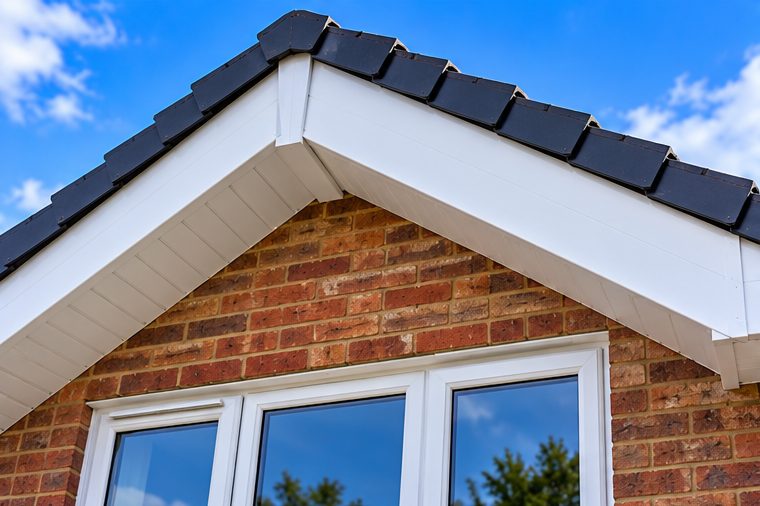
Soffits are the boards under the overhang of your roof, filling the gap between the wall and the fascia. They are easy to ignore because you only see them by looking up, yet they close off the space that would otherwise let birds, wasps and weather into the roof. This guide covers UPVC Soffit Installation for homes in Lincolnshire, how to tell whether yours need attention, and what to ask before any work begins.
Many older houses still have timber soffits that have flaked, sagged or darkened with damp. UPVC Soffit Replacement is a common answer because the new boards need no repainting and cope well with wet, windy weather. It is not always the whole story, though, and sometimes Soffit Repairs on a few boards are enough. We explain how to decide, in plain terms, without pushing you towards more work than the house needs.
Look up from the garden on a dry day with a pair of binoculars if you have them. Peeling or bubbling paint, dark stains, black mould and boards that bow downwards all point to moisture. Gaps at the wall or holes where birds or insects have got in mean the roof space is no longer sealed. Soft timber that gives when pressed is the clearest warning. Water usually reaches soffits from a leaking gutter or a slipped joint above, so a soffit in poor condition often tells you something about the guttering as well. Inside the loft, check for daylight at the eaves, damp patches on rafter ends or signs of nesting. None of these are urgent in the way a leaking roof is, but leaving them tends to spread the damage to the fascia and rafters.
Soffit Repairs make sense when the damage is limited: one or two boards stained by a past gutter leak, a section knocked loose by a ladder, or a small gap that needs closing. The boards either side should be sound and the fixings behind them solid. Replacement is usually better when the timber is soft along whole runs, when the paint has failed everywhere, or when the fascia is being renewed anyway. Soffits and fascias are connected, and taking one off often disturbs the other. Because access is a big part of the work, doing it all in one visit can save disruption and repeated set-up. We will look at the condition of the rafter ends and tell you honestly which approach suits your house.
The sequence is fairly standard, though details change from house to house. A typical job looks like this:
White is the most common choice because it blends with most houses, but black UPVC and woodgrain finishes are also used, particularly where the windows are dark. Plain flat boards look clean and are simple to wipe down, while tongue and groove style boards have a more traditional appearance. Ventilation deserves real thought. A loft needs air moving through it to avoid condensation, and the soffit is often where that air enters, so we will check whether your roof needs vented boards or discreet vent strips. If you are also considering new guttering, black and white UPVC guttering are both common matches. Seamless guttering, which is formed in continuous lengths for the run, is another option; ask us whether it suits your property.
Soffit work is priced on the length of the eaves, the height of the building and how easy it is to get at them. A bungalow with a single run is quicker than a three-storey house with a gable, a porch and an extension, and scaffolding adds to the effort on taller roofs. The condition of the timber behind the old boards matters, because rotten battens or rafter ends need extra work. Whether you are replacing fascias and gutters at the same time changes the plan, as does the choice between plain and vented boards. We will not give a figure without seeing the house, and the quotation will list what is included so you can compare it fairly.
Use the phone or WhatsApp buttons on this page to request a free quotation. It helps if you can tell us roughly how many sides of the house are affected, whether the building is a bungalow or has two storeys, and what you have noticed, such as peeling paint, gaps or birds in the eaves. Photos from the ground are plenty to start with. We are based in Beckingham near Lincoln and cover Lincolnshire, including Lincoln, Boston, Sleaford, Grantham, Louth, Skegness, Spalding and Gainsborough. We will look at the whole roofline, tell you what is worth doing now and what can wait, and put it in writing.
For upvc soffit installation, replacement and repairs anywhere in Lincolnshire, call or WhatsApp 07561 405402, or use the form below and tell us about the job.
Pictures are for illustration purposes only.
See all Fascias & Guttering services in Lincolnshire →
Very little. An occasional wipe with warm soapy water and a soft brush removes dust and algae. They do not need painting. It is still worth checking the gutters above, because overflow and leaks are what cause staining and damage to the boards and the timber behind them over time.
Often yes, if the fascia boards are sound. But the two are joined, so the fascia may need to come off or be disturbed to get the old soffit out. If the fascia is old or worn, renewing both together is usually more sensible and saves setting up access twice.
Properly fitted boards close the gaps they use to get in, which helps. Existing nests are a separate matter, and you should check the roof space first. We can talk through what we find and what the options are before the work starts.
Tell us about the job and we will be in touch.
Prefer to talk? Call 07561 405402 or WhatsApp us.