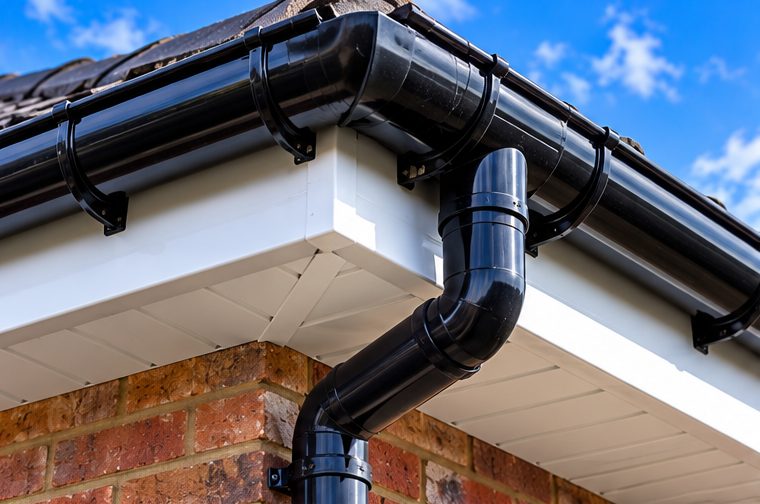
The fascia is the long board running along the bottom edge of your roof, and it holds up your guttering as well as closing the gap under the tiles. When old timber starts to flake, sag or go soft, many homeowners look at plastic as a lower-maintenance alternative. It is a job that looks simple from the ground but has more to it than most people expect.
This guide covers UPVC Fascia Installation on new builds and extensions, and UPVC Fascia Replacement on older houses across Lincolnshire. We look at how the job is done, which choices you will be asked to make and what to check before work begins, so you can speak to a roofer with confidence, compare quotes sensibly and avoid paying for work that is not needed.
Replacing a fascia begins with taking off the guttering, because it is fixed to the board you are removing. The old fascia is then taken away, and the roofer checks what is behind it. Rafter ends, the soffit and the wall plate are all visible at that point, and any rot needs dealing with before new boards go up. New UPVC boards are cut to length and fixed to the rafter ends, with joints made neat and tight. Often the soffit boards beneath are replaced in the same visit, since access is already in place. Finally the guttering is refitted or new lengths are installed. On a new build or extension, the process is simpler because there is nothing to strip out first. Work is done from scaffold, a tower or a platform, depending on the height of the house, and it normally goes along the whole run of each elevation.
White is the most familiar choice, and black is also common, especially on cottages, barn conversions and modern houses with dark window frames. Other finishes, such as woodgrain effects, are also made, and you should ask what is available for your property. Think about how the fascia will sit alongside the windows, doors and gutters, because a mismatch is noticeable from the road. Boards come in different depths and profiles, and some are square-edged while others have a rounded or ogee style. Ask your roofer to show you samples rather than guessing from a screen. Black and white UPVC guttering are both commonly fitted with matching fascias. If you are interested in seamless guttering, which is formed as continuous lengths for the run, ask us whether it suits your property, because it depends on the layout of the roof.
UPVC does not need painting or the repeated preparation that timber demands, and it does not rot in the same way, which is why it is popular in damp, windy parts of Lincolnshire. Wiping it down now and then is usually all it needs. It is not maintenance-free forever, though. Joints can open, cheap or poorly fitted boards can warp, and white plastic can discolour over time in some conditions. Timber still has a place on listed or period buildings, or where appearance rules require it, and a good painted timber fascia can last a long time when kept up. If your house is in a conservation area, check what is allowed before choosing plastic. If you are unsure which suits your property, we are happy to talk it through before you decide.
The most common error is covering up a problem. New plastic fixed over soft rafter ends or a rotten wall plate will not stop the decay, so insist that the structure behind the fascia is inspected and sorted out. Another is forgetting ventilation: roof spaces need air movement, and the soffit or vents should allow for it. Poor joints and uneven falls on the guttering show up as overflowing water and stained walls. It is also worth asking how old boards will be disposed of, and whether the quote includes the guttering and downpipes or only the boards. Make sure the quote states what happens if hidden rot is found, so there are no surprises halfway through. If there is any chance of asbestos-containing materials on an older property, mention it and take advice before disturbing them.
The size of the job is driven mainly by the length of roofline to be covered and the height of the building. A bungalow with a simple roof is a different proposition from a three-storey house with several gables and a porch. Access is a major factor, because scaffold or tower hire is part of the work on taller properties. The state of the timber behind the old fascia matters, as does whether soffits, bargeboards, gutters and downpipes are being replaced at the same time. Your choice of style and colour affects the materials needed. Doing everything in one visit is often more efficient than returning for each part separately. A proper quote will itemise these things, so ask for it in writing and compare it like for like with any others you receive.
Getting a quotation from us costs nothing. It helps if you can tell us what type of property you have, roughly how much of the roofline needs doing, and whether you want white, black or something else. Photographs of the existing fascias, taken from the ground, are useful, along with a note of any dripping or overflowing gutters. We cover Lincoln, Boston, Sleaford, Grantham, Louth, Skegness, Spalding, Gainsborough and the surrounding area. After talking things through and looking at the job, we put the details in a written quote so you can see what is included. Use the call or WhatsApp buttons on this page, or fill in the contact form, and we will come back to you to arrange a convenient time.
For upvc fascia installation and replacement anywhere in Lincolnshire, call or WhatsApp 07561 405402, or use the form below and tell us about the job.
Pictures are for illustration purposes only.
See all Fascias & Guttering services in Lincolnshire →
Not always, but it often makes sense. The scaffold is already up and the boards sit together, so doing both avoids a second visit. If the existing soffits are sound they can sometimes stay. We can tell you once we have looked at them.
It depends on the length of roofline, the height of the building and what is found behind the old boards. A small house is usually quicker than a large one with several elevations. We can give you a realistic idea once we have seen the property.
Sometimes, but old gutters are often removed to fit the boards and may be brittle or sagging by then. Many homeowners choose to renew them together. Tell us what you have and we will advise whether it is worth reusing.
Tell us about the job and we will be in touch.
Prefer to talk? Call 07561 405402 or WhatsApp us.