Look at the edge of your roof from the road. The boards under the tiles, the panels beneath the overhang and the gutters hanging off the front all form your roofline. When it is tired, you get peeling paint, sagging gutters, birds nesting in gaps and damp creeping into the eaves. Roofline replacement tackles all of it at once instead of chasing one fault after another.
This guide explains the parts involved, why doing the job as a whole often makes more sense than piecemeal repairs, what UPVC offers and how to approach a quote. It is written for Lincolnshire homeowners, and the details always depend on the particular house, so treat it as a starting point for a conversation.
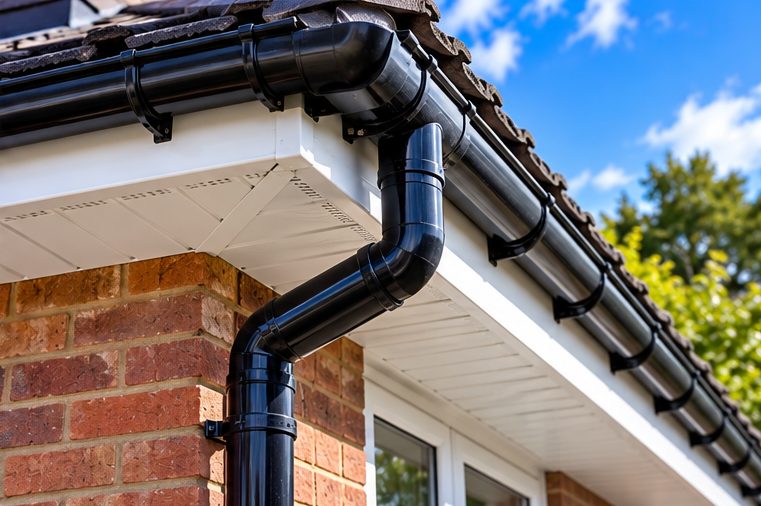
Four components usually work together at the eaves. Fascia boards run along the ends of the rafters and carry the gutters. Soffits close the gap underneath the overhang and often hold small vents that let the roof space breathe. Bargeboards do the same job along the sloping gable edges. Guttering and downpipes then take the water away. Because these parts fix to one another, a failure in one often affects the rest. A rotten fascia cannot hold a gutter firmly, and a leaking gutter will soak the fascia behind it. Looking at them as a single system explains why partial fixes so often need revisiting.
Repairs are sensible where a short length is damaged and the rest is sound. But where timber has been painted repeatedly and is rotting in several places, patching tends to buy only a little time. A complete fascia and soffit replacement lets the rafter ends be inspected, any damp timber dealt with and everything fitted in one consistent run. Access is the other reason. Scaffolding is usually the biggest practical part of roofline work, so doing the fascias, soffits and gutters in one visit avoids paying to put it up twice. A clean, continuous finish also looks tidier than a patchwork of old and new sections.
UPVC roofline cladding is the usual choice for replacements. Boards and panels are fitted over or in place of the old timber, and the material does not need repainting, which is why many owners like it. White is the most common finish, though other colours and wood-effect options exist. It is worth knowing the trade-offs: cladding over existing timber only makes sense if the timber beneath is sound, because covering rot hides it rather than curing it. Where boards are rotten they should be removed first. Ventilated soffit panels also matter in a roof that needs airflow. We will tell you honestly which approach suits your eaves.
Since the gutters fix to the new fascia, replacing them at the same time usually makes sense. Black and white UPVC guttering are both common, and a half-round, square or deep profile can be matched to the look and the rainfall your roof sheds. Seamless guttering, which is formed in continuous lengths made to fit the run, avoids joints that might leak, but it is not right for every house, so ask us whether it suits your property. Check that downpipes are in good order and that outlets drain freely, since a gutter is only as good as what it empties into.
Roofline quotes vary widely, and the reasons are mostly practical. These are the usual factors:
F H Roofing is based in Beckingham near Lincoln and covers Lincolnshire, including Lincoln, Sleaford, Grantham, Skegness and surrounding areas. Describe what you can see: peeling or rotten boards, sagging gutters, gaps at the eaves. We will visit, look at the whole roofline and explain what needs replacing and what can stay. The free quotation sets out the work clearly, so you can see exactly what is included before deciding.
For complete roofline replacement and cladding anywhere in Lincolnshire, call or WhatsApp 07561 405402, or use the form below and tell us about the job.
Pictures are for illustration purposes only.
See all Fascias & Guttering services in Lincolnshire →
Sometimes, if the timber behind is sound and firmly fixed. If it is rotten, covering it simply hides the problem and the damp can spread. A close look at the boards and rafter ends will show whether cladding over or full removal is the better route.
The gutters fix to the fascia, so taking them down is part of the job anyway. Fitting new ones at the same time avoids repeat scaffolding and gives a matching, properly aligned finish with correct falls to the downpipes.
It should be, if vented soffit panels or eaves vents are included where the roof needs them. Ventilation helps prevent condensation in the roof space. Mention any existing vents when we visit so they are kept or improved.
Tell us about the job and we will be in touch.
Prefer to talk? Call 07561 405402 or WhatsApp us.