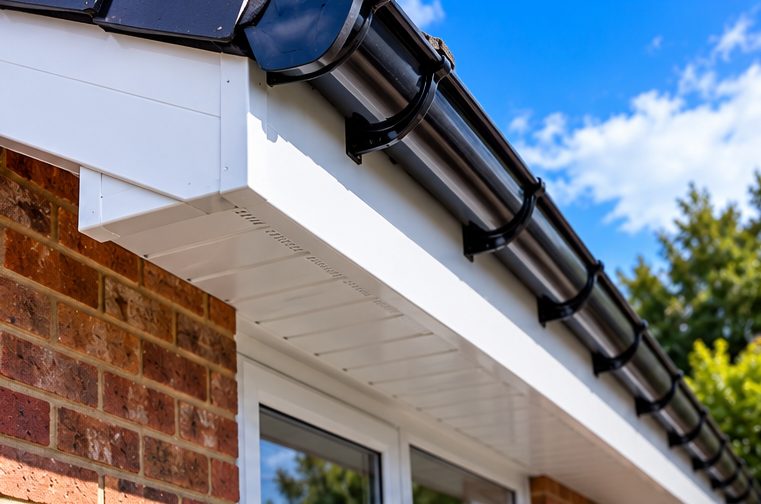
A gutter does a plain job: it collects rain from the roof and carries it away from the walls. When it fails, you notice it quickly, with water spilling over the edge, dark streaks down the brickwork, or a damp patch appearing after a storm. The question most people ask is whether it is worth mending what they have or whether the time has come to replace it.
There is no single answer, and anyone who gives one without looking at the roofline is guessing. This guide sets out how to judge between gutter repairs and gutter replacement, what the common UPVC options look like, what to check yourself from the ground, and how to approach a quote in Lincolnshire without being surprised.
Gutters rarely fail without a reason, and the reason decides the fix. Water pouring over the front edge during a downpour often means a blockage, not a faulty gutter. Drips at the joints point to worn seals or a section that has dropped out of line. A sagging run suggests brackets have loosened, or the fascia behind has weakened. Cracks and brittle, faded plastic suggest the material is simply old. Walk around the house during rain if you can, from a safe position on the ground, and note where the water goes. Take photographs of the places it spills or drips. This does not need ladders, and it gives a roofer something far more useful than a vague description. Mention any recent changes too, such as a new extension or a tree that has grown close to the roof.
Gutter repairs make sense when the problem is limited and the rest of the system is sound. Typical examples include resealing or replacing a joint, refitting a few brackets, realigning a sagging section so water falls towards the outlet, replacing one cracked length, and clearing and flushing a blocked downpipe. These are small jobs with a good chance of success, and they avoid replacing materials that still have life in them. Repairs are less convincing when the same gutter has been patched more than once, when the plastic has turned brittle, or when the joints leak along most of the run. At that point you are paying again and again for a system that is wearing out. A good roofer will tell you openly when a repair is worth doing and when it is simply postponing the inevitable.
Gutter replacement is worth considering when the system is old, widely cracked, repeatedly leaking or the wrong size for the roof it serves. Replacing the whole run gives you clean, correctly aligned lengths with fresh seals, new brackets and downpipes where needed. It is also the moment to look at the fascia boards behind, because gutters are fixed to them, and new guttering on rotten timber will not stay put. Many houses already have UPVC guttering, which is light, does not rust and needs little upkeep. Black and white are the most common colours, and which looks right depends on your roofline and window frames. Some firms also offer seamless guttering, which is formed as continuous lengths for the run, reducing the number of joints. Ask us whether it suits your property. Where the roof is large, deeper or wider profiles may cope better with heavy rain.
Regular care extends the life of any gutter. Leaves, moss from the roof and windblown debris collect quickly, especially beside trees, and a blocked gutter overflows, which is a common reason for damp walls and rotten fascias. Look at your gutters after autumn leaf fall and again in spring. Signs worth acting on include:
Gutter work is quoted according to the length of the run, the height of the house and how much is being replaced. A bungalow with clear ground around it is quicker to work on than a three-storey property or one with a conservatory in the way, since access equipment or scaffolding may be needed. The material and profile matter, as do the number of corners, stop ends and downpipes. If fascias or soffits need attention at the same time, that is a separate but related piece of work. The condition of the brackets and the state of the existing downpipes also play a part. When comparing quotations, check that each lists the same quantity of gutter, the same number of downpipes, and what happens to the old material. A fair quote will make all of that visible.
If your gutters are overflowing, leaking or coming away from the house, we offer free quotations across Lincolnshire, including Lincoln, Louth, Grantham, Gainsborough and Sleaford. Tell us what you have noticed, where the water goes and roughly how long the problem has been there. Photographs from the ground are helpful. We will look at the guttering, the fascia behind it and the downpipes, then explain whether gutter repairs will do the job or gutter replacement is the better route, so that the decision is clear before any work begins. If a storm has caused sudden damage, our 24-hour emergency call-out is available.
For gutter repairs and gutter replacement anywhere in Lincolnshire, call or WhatsApp 07561 405402, or use the form below and tell us about the job.
Pictures are for illustration purposes only.
See all Fascias & Guttering services in Lincolnshire →
A small drip can sometimes be sealed temporarily, but working at height carries real risk, and a poorly sealed joint tends to fail again. If you cannot reach the gutter safely from the ground, leave it to a roofer.
Not always. If the fascia is sound, new guttering can often be fixed straight to it. If the timber is soft or rotten, it should be dealt with first, because gutters need a firm fixing to stay in line.
Not necessarily. It suits some roofs and not others, depending on the length of the run and the access available. Ask us whether it suits your property, and we will explain the options honestly.
Tell us about the job and we will be in touch.
Prefer to talk? Call 07561 405402 or WhatsApp us.