Some roofs shed far more water than a standard half-round gutter can comfortably carry. You see it when rain pours over the front edge in a downpour, or when a long run of guttering overflows at the corner every time the weather turns. In those cases, simply replacing like for like may not cure the problem.
Deep flow guttering is a UPVC profile with a deeper channel that holds and moves more water. This guide explains where it helps, what else has to be right for it to work, and what to think about before you ask for a quote. It is general guidance for Lincolnshire homeowners, not a verdict on your own roof.
A deep flow gutter has a deeper, often squarer or more rounded channel than the shallow half-round type found on many older houses. That extra depth gives rainwater more room, so it is less likely to slop over the lip when the roof is shedding heavily. It is made from UPVC, the same plastic family as most modern roofline products, and is normally sold with matching brackets, stop ends, unions, corners and outlets. Black and white are the most common colours, and brown or grey options are often available. Because the parts are system-specific, it is important not to mix different profiles on one run.
A deeper channel earns its place in particular situations. Think about whether any of these describe your property.
A big gutter will not help if the water cannot leave it. The number and position of downpipes matter as much as the channel, and a long run with one outlet at the end can still overflow. Falls also need to be set carefully so water travels towards the outlet rather than pooling in the middle. Brackets should be spaced closely enough to carry the weight of a full gutter, and the fascia behind needs to be sound to hold it. Sometimes a second downpipe or a repositioned outlet does more than changing the profile, which is why a proper look at the whole run is worthwhile.
Fitting usually starts with removing the old gutters and checking the fascia boards for rot or movement. Any weak timber is better dealt with before new brackets go on. The new run is then set out with a consistent fall, joined with the correct unions and finished with outlets and downpipes. Depending on height and access, ladders or scaffold towers may be used. Afterwards, gutters still need a clear-out once or twice a year, particularly after autumn leaf fall. If you are interested in seamless guttering, which is formed as continuous lengths for the run, ask us whether it suits your property.
The price of a guttering job depends on the total length, the height of the building and how easily the work can be reached. A bungalow with simple elevations is quite different from a tall house with several roof levels. The number of corners, outlets and downpipes changes the parts list. Extra work, such as replacing fascia boards, altering drainage connections or removing old cast iron, adds time. Ask for the quote to list the profile, colour, number of downpipes and any timber repair so that different quotes can be compared fairly.
For a free quotation, contact F H Roofing and tell us about the problem you are seeing: where the water overflows, how long the run is and what the guttering is made of at present. A few photos from the ground help. We will talk through whether deep flow guttering is the right answer or whether better outlets or a repair would do the job, and arrange a visit to look at the roofline. We cover Lincoln, Boston, Sleaford, Grantham, Louth, Skegness, Spalding and Gainsborough.
For deep flow guttering anywhere in Lincolnshire, call or WhatsApp 07561 405402, or use the form below and tell us about the job.
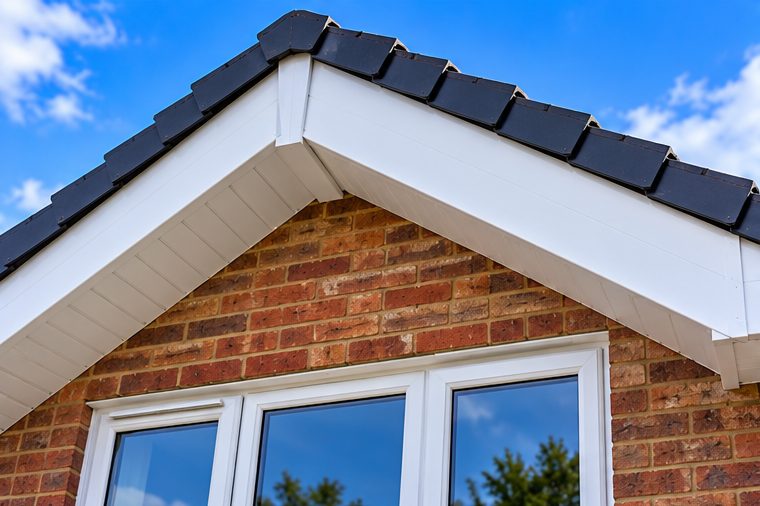
Pictures are for illustration purposes only.
See all Fascias & Guttering services in Lincolnshire →
Not always. It suits larger or steeper roofs and places that overflow, but needs a sound fascia and enough downpipes to work properly. On a small, simple roof a standard profile may be perfectly adequate. A visit to check the roofline will show which makes sense.
Black and white are the most common, and other colours such as brown and grey are often available depending on the system. Choose something that suits your fascias and downpipes so the roofline looks consistent. Ask us what is available when we discuss your quote.
No. It carries more water, but leaves and moss can still collect, particularly under trees. Regular clearing is still needed. A larger channel may take longer to overflow once debris builds up, but it does not replace routine maintenance.
Tell us about the job and we will be in touch.
Prefer to talk? Call 07561 405402 or WhatsApp us.