Lincolnshire sits low and open, and when a strong gale comes in off the Wash or across the fens, a roof takes the full force of it. Tiles lift, ridge pieces shift and flashing peels back, sometimes without you hearing anything at all in the night. It is natural to want to know how serious it is and what to do first.
This guide covers Storm Damage Roof Repairs from the first look around the garden to the finished job. It explains what Wind Damaged Roof Repairs usually involve, how to keep safe and dry in the meantime, and how to approach Roof Repairs After High Winds without being rushed into decisions you might regret later on. Take it one step at a time.
Walk round the outside of the house and look up from a safe distance. Signs to watch for include tiles or slates lying on the ground, gaps in the roof slope, a ridge that looks uneven, hanging gutters and fascias, and bent or missing flashing. Inside, check the loft with a torch if you can do so safely from the hatch, and look at ceilings for new stains or drips. Take dated photographs of everything. Never go up a ladder to the eaves, let alone onto the roof, in or just after high winds, because gusts continue and surfaces are slippery. Keep people and pets away from anywhere debris could still fall. If water is coming in or something is clearly unsafe, call straight away. We offer a 24-hour emergency call-out, although we cannot promise a particular arrival time.
Wind works on a roof in two ways. It pushes against windward slopes, and it creates suction on the leeward side and at the edges, which tries to pull things upward. That is why damage clusters around ridges, verges, eaves and corners. Loose or nail-sick tiles are the first to go, then ridge and hip tiles whose mortar has aged. Lead flashing can be lifted and folded back, letting rain behind it. Chimney pots and cappings can be dislodged. Flat roofs may have felt or membrane lifted from edges. Outbuildings, sheds and garage roofs are often hit hardest. A single missing tile may look minor, but it exposes the membrane and battens below, so even small gaps are worth getting fixed quickly.
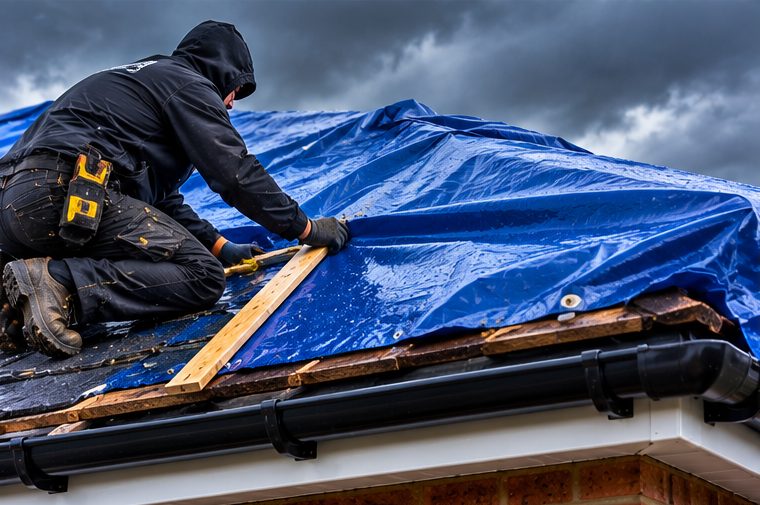
Where rain is coming in, the first job is usually to make the roof watertight with a temporary repair, for example sheeting or boarding over the damaged area, or refixing loose pieces. This stops further damage and gives you time to plan. The permanent repair then replaces broken or missing tiles and ridge pieces, refixes slipped ones, repairs or renews flashings, and rebuilds any disturbed pointing. Matching tiles can be a challenge on older roofs, so a roofer may need to take spares from a less visible slope. If wind has damaged battens or rafters, those must be put right as well. Sometimes the tidier option is to renew a whole section rather than patching many spots. We will explain which approach makes sense, and why, before any work starts.
If you think you may want to claim, it is wise to contact your insurer early. Take photographs of the damage, inside and out, before anything is moved. Keep damaged materials if it is safe to do so, as they can show what happened. Hold on to any written notes from the roofer about the work carried out. We can talk through what the repair involves and put the details on paper, but we do not advise on policies or on what an insurer will decide, so please check cover and procedure with them directly. Do not delay urgent protection of the property while waiting for approval, as keeping further water out is usually something you are expected to do. Ask your insurer if you are unsure about this.
Because every storm leaves different damage, a figure over the phone would be guesswork. Quotes depend on how many tiles, ridge units or flashings need work and how easy the roof is to reach. Steep or tall roofs may need scaffold or a tower. Temporary protection, if required, is a separate element from the permanent repair. The roof covering and whether suitable replacements can be found affects both time and materials. Hidden problems, such as damaged battens, wet insulation or rot found once tiles are lifted, can add to the work, so ask how these will be handled and agreed. Out-of-hours emergency work is arranged differently from planned repairs. A written quote should list exactly what is included, so you can see what you are agreeing to.
For planned repairs after a storm, we offer free quotations. Please tell us what you have noticed, whether water is getting in, and roughly where in Lincolnshire you are. Photographs from the ground are very helpful. We work across Lincoln, Boston, Sleaford, Grantham, Louth, Skegness, Spalding, Gainsborough and the areas around them. If the situation is urgent, say so at the start and ask about our 24-hour emergency call-out. Use the call or WhatsApp buttons on this page, or the contact form for less urgent enquiries. We will talk through the likely repair, explain it in plain language and confirm the details in writing.
For storm damage and wind damaged roof repairs anywhere in Lincolnshire, call or WhatsApp 07561 405402, or use the form below and tell us about the job.
Pictures are for illustration purposes only.
See all Storm Damage Repairs services in Lincolnshire →
No. Roofs are dangerous in and after high winds, and tiles can be loose underfoot. Look from the ground, use binoculars or a phone zoom, and photograph what you see. A roofer can inspect it safely, photograph the damage and explain what needs doing, which beats guessing from below.
It can be. A gap lets rain reach the membrane and battens, and over time the water can get into the loft and ceilings. Neighbouring tiles may also loosen. It is sensible to arrange a repair soon, and a temporary cover if rain is forecast.
We have a 24-hour emergency call-out for urgent situations such as water coming in or a roof that is unsafe. We cannot promise arrival times, but we will do what we can to help, and we will advise on making things safe in the meantime.
Tell us about the job and we will be in touch.
Prefer to talk? Call 07561 405402 or WhatsApp us.