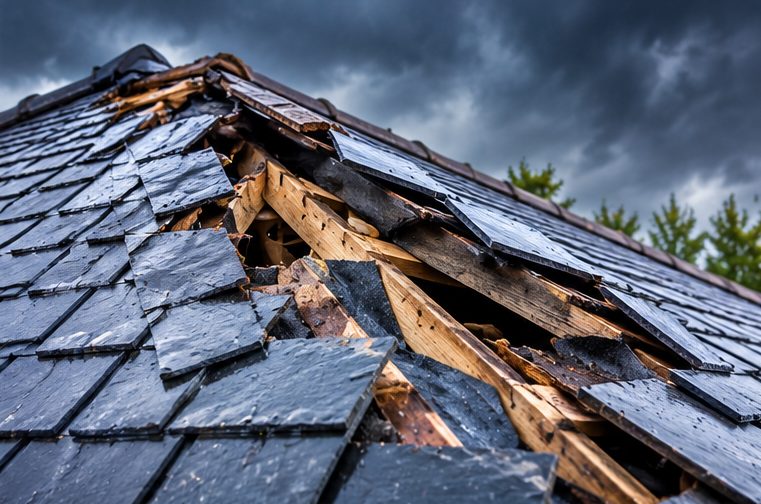
Slate is tough, but a strong gale can still lift, crack or strip it. You might find fragments on the lawn, a gap on the roof that was not there yesterday, or a stain spreading on a bedroom ceiling. It is an unsettling moment, and it is easy to make hasty decisions or to ignore the problem and hope it goes away.
Storm damaged slate roof repairs are approached most sensibly and in order: make things safe, limit further damage, record what happened, then arrange a proper repair. This guide explains each stage for Lincolnshire homeowners, what a repair typically involves, and what to say when you contact a roofer, so you can act without guesswork.
Your own safety comes before the roof. Do not climb up to look, and keep children and pets away from areas beneath damaged slates, because loose pieces can still fall. From the ground, or from an upstairs window, look for missing or slipped slates, broken ridge sections, displaced lead around chimneys and damage to gutters. Indoors, check the loft and ceilings for drips, damp patches or daylight. Place a bucket under any leak and move belongings out of the way. Switch off lights or sockets close to wet ceilings if you are concerned. If water is coming in quickly, or a large area of the roof has gone, contact a roofer straight away. We run a 24-hour emergency call-out for these situations, although we cannot promise a particular arrival time.
It is wise to contact your insurer early, because they will tell you what they need from you. While things are fresh, take clear photographs of the damage from the ground and inside the house, and note the date and what the weather was doing. If it is safe to do so, keep any broken or fallen slates rather than throwing them away, as they may be useful evidence. We cannot advise on your policy or on how a claim will turn out, and it would be wrong to pretend otherwise. What we can do is talk you through what the repair involves, explain what we find on the roof, and describe the work in plain terms so you can pass that information on. Keep any paperwork or notes from your contact with the insurer in one place.
If a repair cannot happen at once, the aim is to keep the weather out. A temporary fix might be a securely fixed tarpaulin or sheet over the damaged area, or sometimes a few replacement slates fitted to close the worst gaps. Done properly, this limits the water getting into the loft and ceilings. It is a stopgap and should not be mistaken for the finished repair. Temporary covers must be fixed so the wind cannot get beneath them, which is why they should not be a do-it-yourself job from a ladder in a gale. On a slate roof, walking about can crack more slates, so working methods matter. Once the roof is protected, there is time to inspect the whole slope properly, rather than rushing a repair in poor conditions.
Slates are held by nails, or by clips and hooks, and a storm often breaks the fixing as well as the slate. A repair usually means removing the broken pieces, checking the battens and underlay beneath, and fitting replacements that match the size, colour and thickness of what is already there. Matching can be tricky on older roofs, where the existing slates may be Welsh, Spanish or reclaimed, and your roofer should explain the options. Ridge tiles, hips, verges and lead flashings are also exposed to wind and should be checked during the same visit. If lots of slates are slipping across a wide area, the nails or battens may have given up, and that points to a larger repair or partial re-roof. Honest advice here saves money in the long run.
The cost of slate repairs follows the extent of the damage and the effort of getting to it. A handful of slipped slates in an accessible spot is a smaller job than damage across several slopes. Steep or tall roofs need scaffolding or other safe access, which is part of the work rather than an optional extra. The number of slates to replace, the availability of a match, and whether battens, underlay, ridges or flashings need attention all change the scope. Emergency work outside normal hours is quoted separately from planned repairs. Ask for a written quotation that separates the temporary protection from the permanent repair, so you can see what each stage covers, and so that anything an insurer needs is clear.
If a storm has damaged your slate roof in Lincoln, Louth, Skegness, Gainsborough or anywhere else we cover in Lincolnshire, get in touch. For planned repairs we offer free quotations, and for urgent leaks our 24-hour emergency call-out is there when you need it. When you call, tell us what you saw, where the water is coming in and whether anyone is at risk. Send photographs if you have them, but do not go onto the roof yourself. We will explain the temporary measures, the permanent repair and the likely sequence of events, and you stay in control of each decision.
For storm damaged slate roof repairs anywhere in Lincolnshire, call or WhatsApp 07561 405402, or use the form below and tell us about the job.
Pictures are for illustration purposes only.
See all Storm Damage Repairs services in Lincolnshire →
No. A damp slate roof is slippery, and loose or cracked slates can break under your weight. Look from the ground with binoculars or from an upstairs window, take photographs, and let a roofer inspect the roof safely.
It is risky. Even small gaps let wind-driven rain reach the underlay, battens and loft insulation, and the damage spreads quietly. A temporary cover can protect the roof until a permanent repair is arranged, and it is wiser to deal with it promptly.
Often a close match can be found, though weathering means new slates start out looking slightly different. On older roofs, reclaimed slates may help. Your roofer should explain the options and show you samples where possible before the work begins.
Tell us about the job and we will be in touch.
Prefer to talk? Call 07561 405402 or WhatsApp us.