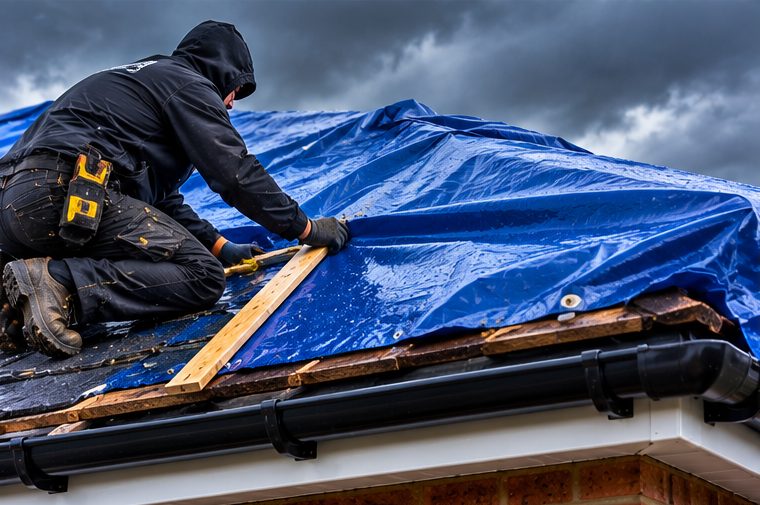
Flat roofs have large, open surfaces and light coverings, so they feel the full force of a storm. After a night of high wind, you may find felt peeled back at an edge, a corner of the covering lifted, flashings pulled away from a wall, or a pool of water where there was none before. Debris or a fallen branch can cause punctures too.
This guide explains how to deal with Storm Damaged Flat Roof Repairs sensibly: what to do in the first hour, how temporary protection works, what a lasting repair involves, and how to approach your insurer. It also covers when a repair makes sense and when a flat roof has simply had its day.
Keep safe first. Do not climb onto a wet or damaged flat roof, and stay out of rooms where ceilings are bulging or dripping heavily. Limit the water inside by moving belongings, putting buckets under drips and, if a ceiling is sagging with water, making a small hole to let it drain into a container if you can do so safely. Photograph everything you can see from the ground and from inside. If the roof is open to the weather or water is coming in, our 24-hour emergency call-out is there for exactly this, though we cannot promise an arrival time.
Wind tends to attack the edges, because that is where the covering is anchored and where air gets underneath.
A temporary repair is meant to stop water getting in until proper work can be done. It may be a patch, a sheeting cover or sealing a split, and it should be treated as short-term only. A lasting repair depends on the covering. A torn section of felt can often be cut out and replaced, an edge re-fixed and trims renewed, while rubber or fibreglass surfaces need their own matching methods. The important step is checking the deck beneath. Boards that have been wet for a while soften, and covering them with new material without replacing them simply hides the next failure.
If the roof was in good condition before the storm, a repair usually makes sense. If it was already tired, with blistering, multiple patches, ponding or a worn surface, then storm damage may be the point where full replacement becomes the more sensible choice. Paying repeatedly for patches on a failing roof rarely works out well. A candid assessment should tell you what has been caused by the storm and what was pre-existing, and your roofer should be willing to explain the difference in plain terms, without pushing a bigger job than needed.
It is wise to contact your insurer early. Take photos of the damage and the surrounding area, keep any damaged materials if it is safe to do so, and make a note of when you noticed it. We cannot advise on policies or claim outcomes, but we can talk through what the repair involves and describe the work in writing so you understand what is being proposed. Keep copies of any paperwork, and hold off on permanent work until you have checked what your insurer needs from you.
Costs vary with the roof size, the covering, the extent of the damage and how easy the roof is to reach. A small patch at one edge is a different matter from a lifted section across a whole extension. Deck condition, the need for new trims or flashings, drainage problems and any urgent temporary work all play a part. Out-of-hours emergency work is likely to differ from planned repairs. Ask for a quote that separates temporary protection from permanent repair, so you know what each stage covers.
For storm damage to a flat roof across Lincolnshire, including around Lincoln, Boston, Skegness and Gainsborough, you can ask us for a free quotation, and for urgent leaks our 24-hour emergency call-out is available. Tell us the type of covering, where the damage is and whether water is coming in. Use the call or WhatsApp buttons on this page and we will talk through next steps.
For storm damaged flat roof repairs anywhere in Lincolnshire, call or WhatsApp 07561 405402, or use the form below and tell us about the job.
Pictures are for illustration purposes only.
See all Storm Damage Repairs services in Lincolnshire →
Often, yes, when the damage is local and the rest of the roof is sound. Torn felt, lifted edges and loose flashings can usually be repaired. If the deck is soaked or the covering was already worn out, replacement may be the more sensible option.
If water is entering the building, temporary protection is sensible to limit further damage. It is a short-term measure only. A proper repair should follow once the roof can be inspected and, if needed, the deck dried or renewed.
Contact them early, describe what happened and share your photos. Keep damaged materials if it is safe. We cannot advise on your policy, but we can explain the repair work so you can describe it accurately.
Tell us about the job and we will be in touch.
Prefer to talk? Call 07561 405402 or WhatsApp us.